If you’re a fresher standing at this crossroad right now, you’re not alone — it’s probably the single most debated career question in Indian households. Your parents might be nudging you toward a “safe” government job, while your friends in IT are talking about packages, ESOPs, and work-from-home. Both sides have a point, and honestly, there’s no universally correct answer — only the right answer for you, based on what you actually value.
This guide breaks the decision down honestly, without the bias you’ll find in most “sarkari naukri is best” or “private sector is the future” articles. By the end, you should have a clear framework for deciding — not just a list of pros and cons.
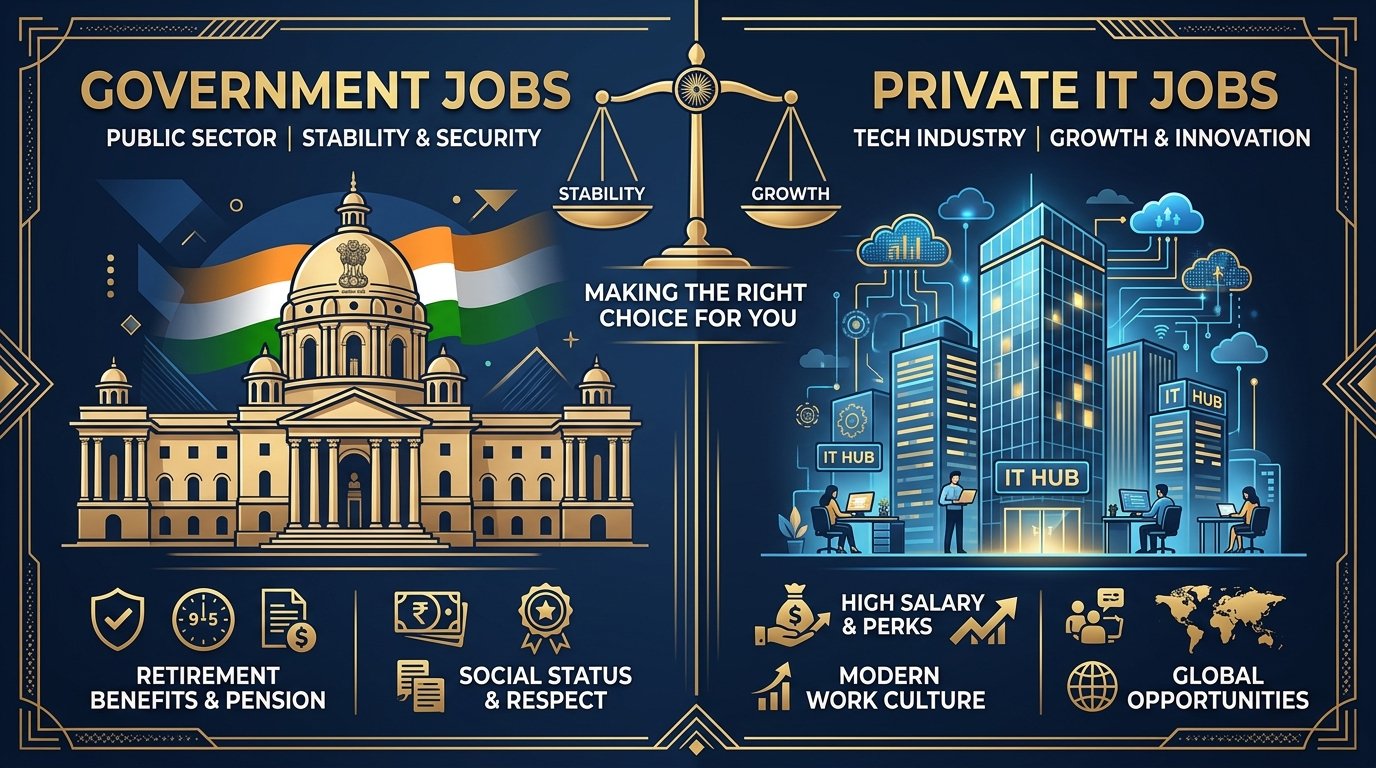
Government Job vs Private Job — Quick Comparison
| Factor | Government Job | Private Job |
|---|---|---|
| Job Security | Very high — near-impossible to lose your job without serious misconduct | Depends on company and performance; layoffs are possible |
| Starting Salary | Often modest, especially at entry level | Can be significantly higher, especially in IT/tech and top MNCs |
| Salary Growth | Slow, structured, predictable (pay commission-based) | Faster, but variable and performance-linked |
| Work-Life Balance | Generally strong, fixed hours, more leave | Varies widely — can be excellent or demanding depending on company/role |
| Career Growth Speed | Slow and seniority-based | Can be fast, especially if you switch companies or perform well |
| Retirement Benefits | Pension, gratuity, strong post-retirement security | Provident fund, gratuity, but no guaranteed pension in most private roles |
| Entry Process | Competitive written exams (often 1–2 years of preparation) | Interviews, technical rounds, sometimes campus placements |
| Skill Development | Slower-paced, process-driven learning | Faster exposure to new tools, technologies, and market-relevant skills |
| Location | Often fixed or subject to transfer policies | Usually more flexibility to choose city/company |
| Social Perception | High respect and stability, especially in smaller towns | Growing acceptance, especially in IT/urban markets |
Government Jobs: The Real Advantages
Unmatched job security. Once you clear probation, it’s extremely difficult to lose a government job except in cases of serious misconduct. In a country where economic uncertainty affects private-sector hiring in cycles, this security is genuinely valuable — especially if you’re risk-averse or supporting a family.
Predictable career and benefits. Pay commissions periodically revise government salaries, and the trajectory — while slow — is transparent. You know roughly where you’ll be in 10, 20, or 30 years. Add pension benefits (for many roles), medical coverage, and housing allowances, and the total compensation package often looks better than the headline salary suggests.
Work-life balance. Fixed working hours, generous leave policies, and lower after-hours expectations are common across most government roles — something increasingly hard to find in high-pressure private sector jobs.
Social standing. In many parts of India, particularly outside metro cities, a government job still carries significant social respect and is often seen as a mark of stability — a real factor if that matters to you or your family.
One option this framing tends to miss sits between the two columns: Public Sector Undertakings. PSUs pay on corporate-style scales while retaining government-grade security, which makes them the closest thing to having both. Our guide to landing a high-paying PSU job as a fresher covers the four entry routes, including the GATE-score pathway that skips a separate written exam entirely.
Government Jobs: The Honest Downsides
- Slow salary growth, especially in your first 10–15 years
- Lengthy, competitive preparation — many government exams have lakhs of applicants competing for a few thousand seats, and serious preparation can take 1–2 years or more
- Limited flexibility in choosing your posting location, especially early in your career
- Slower skill development in fast-moving technical fields, which can make it harder to pivot later if you change your mind
The preparation timeline is worth interrogating rather than accepting, though — it varies enormously by exam. Banking recruitment in particular runs on a far shorter cycle than the civil services, and our six-month roadmap for bank PO and Clerk exams sets out a realistic month-by-month plan for it.
The pension picture also deserves more nuance than “government means pension.” Recruitment schemes vary in what they actually guarantee — the Agniveer scheme’s terms after four years of service are a useful illustration of why it pays to read the specific post-retirement terms of any role rather than assuming the category covers it.
Private Jobs: The Real Advantages
Faster earning potential. Especially in IT, product companies, and finance, private-sector salaries — particularly for in-demand skills — can significantly outpace government pay scales, sometimes within just a few years of experience.
Skill development and market relevance. You’re constantly exposed to current tools, technologies, and business practices. This makes it easier to build a resume that stays relevant and opens doors to better opportunities down the line, including abroad if that’s a goal.
Career mobility. You can switch companies, cities, and even industries far more easily than in government service. If you’re ambitious and don’t mind some risk, this flexibility can accelerate your growth considerably.
Faster entry. Most private roles are filled through interviews and technical assessments that take weeks, not years — compared to the extended exam cycles common in government recruitment. The TCS National Qualifier Test is a good example: one test, sat once, with results feeding directly into interview rounds.
Private Jobs: The Honest Downsides
- Less job security — performance reviews, restructuring, and market conditions can all affect your job, and layoffs do happen, even at large companies
- Variable work-life balance — some companies and roles demand long hours, weekend work, or high-pressure deadlines
- No guaranteed pension in most cases — retirement planning becomes entirely your own responsibility
- Salary and growth depend heavily on your own performance and negotiation, which suits some people and stresses others
That first point is not hypothetical. Our review of fresher hiring trends in Indian tech recruitment documents how sector revenue and headcount have decoupled — the industry is growing while large employers cut roles, which is exactly the risk profile this column describes.
The last point cuts both ways, and it is a skill you can learn rather than a personality trait you either have or don’t. Our guide on how to negotiate salary as a fresher covers what is actually negotiable on an entry-level offer.
How to Actually Decide: A Framework, Not a Verdict
Instead of asking “which is better,” ask yourself these questions honestly:
- How do you feel about risk? If job loss or income variability genuinely stresses you out, government roles offer real peace of mind. If you can handle some uncertainty in exchange for upside, private roles may suit you better.
- What’s your timeline? If you’re willing to spend 1–2 years preparing seriously for competitive exams, government roles are absolutely achievable. If you want to start earning and building experience sooner, private hiring moves faster.
- Do you want to stay in one place, or move around? Government postings can mean transfers across the state or country. Private roles usually let you choose your city (or work remotely, depending on the role).
- How important is fast skill growth to you? If you’re in a technical field and want to stay sharp and marketable, the private sector generally offers faster exposure to current tools and practices.
- What does long-term security mean to you? Government pension and post-retirement benefits are hard to match. But private-sector savings, investments, and career growth can also build strong long-term security if managed well.
There’s no rule that says you have to pick one path forever, either. Many people prepare for government exams while working a private job, and plenty of others start in government roles before eventually moving to the private sector (or vice versa) later in their careers.
A government apprenticeship is one low-commitment way to test the water without giving up two years to exam preparation first — our guide to NATS 2.0 registration explains how that route works.
Frequently Asked Questions
1. Is a government job really more secure than a private job? Generally yes — government roles have significantly stronger job protection than most private-sector positions, barring serious misconduct.
2. Do private jobs always pay more than government jobs? Not always, especially at entry level in non-technical fields. But in high-demand sectors like IT, private salaries often outpace government pay scales over time.
3. Can I prepare for government exams while working a private job? Yes, many candidates do this, though it requires disciplined time management given the demands of both.
4. Which is better for long-term financial security — government pension or private savings? Both can work well if managed properly. Government pensions offer guaranteed income, while private-sector employees need to actively invest (PF, NPS, mutual funds, etc.) to build equivalent security.
5. Is it harder to get promoted in government jobs? Promotions in government roles are typically seniority-based and slower, compared to private roles where performance can accelerate promotions.
6. Do government jobs offer less exposure to new skills and technology? Generally, yes, particularly in traditional administrative roles — though this varies by department and role.
7. Is switching from a private job to a government job (or vice versa) common in India? Yes, it’s fairly common, especially among candidates in their late 20s or early 30s reassessing their priorities.
8. Which sector is better for freshers straight out of college? It depends on your priorities — if you want to start earning and building experience quickly, private roles are usually faster to enter. If you’re willing to invest time preparing for a more secure, long-term career path, government exams are worth serious consideration.
Looking to explore your options in either direction? Browse the latest government job openings or private and IT sector jobs on FreshersJob4U.

Engineering graduate and founder of FreshersJob4U. I write detailed job guides, interview prep resources, and career roadmaps for freshers and early-career professionals in India. This site started from my own experience with the scattered, confusing fresher job search — I wanted to build something cleaner.