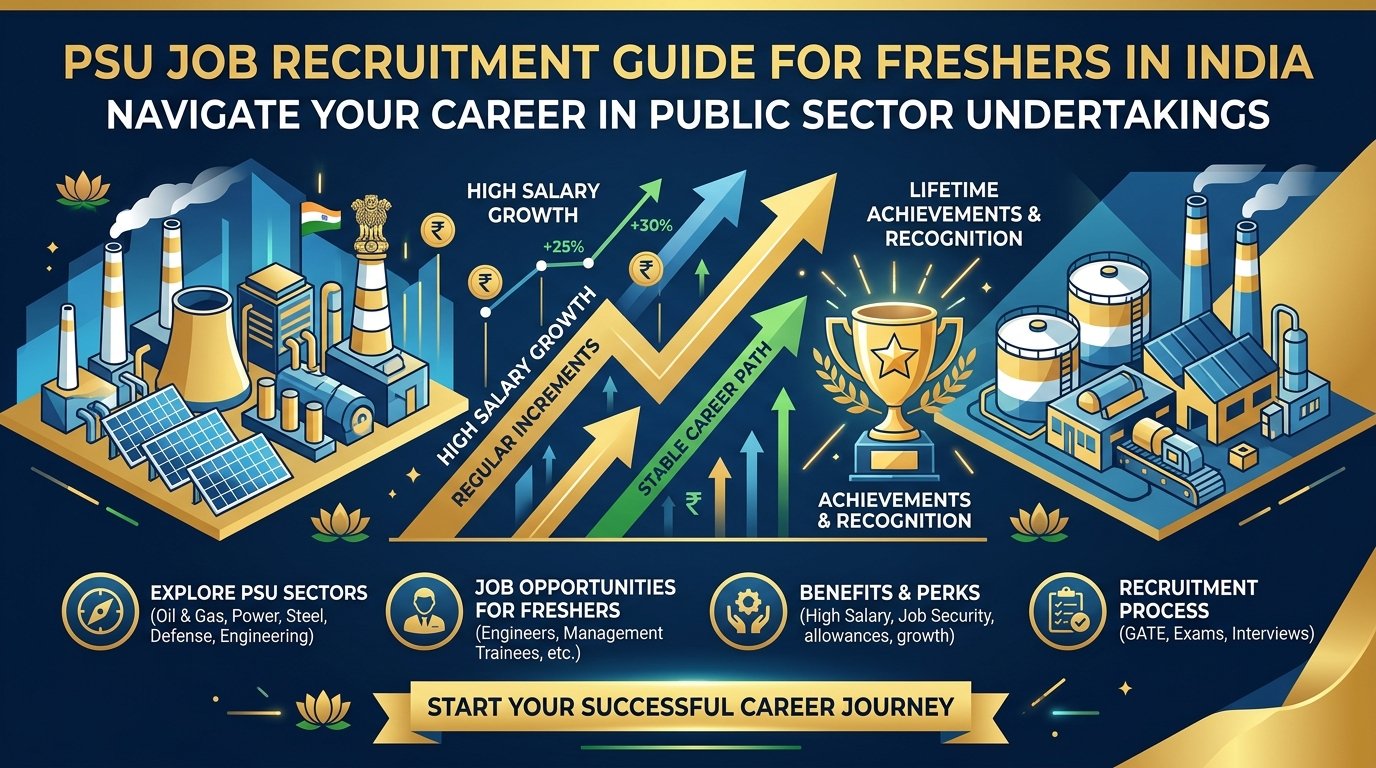
For engineering and professional graduates in India, securing a job in a Public Sector Undertaking (PSU) represents the peak of career stability. Combining the high-paying corporate salary structures with the job security and social prestige of a government job, PSUs are some of the most sought-after employers in the country.
Organizations like Bharat Heavy Electricals Limited (BHEL), Indian Oil Corporation (IOCL), and Hindustan Petroleum (HPCL) attract lakhs of applicants every year. If you are a fresher looking to secure a position in a Maharatna, Navratna, or Miniratna company, having a clear roadmap is essential to beating the intense competition.
This guide outlines the different types of PSUs, their entry pathways, preparation strategies, and how you can position yourself for a high-paying career.
Understanding the PSU Landscape: Maharatna, Navratna, and Miniratna
Not all PSUs are created equal. The Government of India categorizes Central Public Sector Enterprises (CPSEs) based on their financial autonomy, net worth, and annual turnover. Knowing this helps you understand the size and prestige of the company you are applying to.
1. Maharatna PSUs
These are the top-tier giants of the public sector. They enjoy the highest financial autonomy and have an annual net profit of over Rs. 5,000 crores. Examples include Coal India Limited (CIL), NTPC, ONGC, and Indian Oil.
2. Navratna PSUs
These are mid-to-large-size organizations with significant autonomy. To qualify, they must score at least 60 out of 100 on parameters like net profit, cost of services, and manpower. Examples include Bharat Electronics Limited (BEL), NMDC, and Hindustan Aeronautics Limited (HAL).
3. Miniratna PSUs (Category I & II)
These are smaller, highly profitable enterprises with lower investment caps compared to Maharatnas and Navratnas. Examples include Northern Coalfields Limited (NCL) and Cochin Shipyard.
Why You Should Consider a PSU Job
While private IT firms and startups offer rapid growth, PSU jobs offer unique benefits that make them highly attractive. If you are still weighing the two routes, it is worth reading how a government role actually compares with a private-sector one on pay, growth and security before you commit your preparation time.
- Competitive Basic Pay: Under the 3rd Pay Revision Committee guidelines (NCWA-XI for coal sectors), entry-level basic pay scales are extremely competitive, starting at Rs. 40,000 to Rs. 60,000 per month.
- Excellent Allowances: Employees receive Dearness Allowance (DA), House Rent Allowance (HRA), transport subsidies, performance-linked bonuses, and comprehensive medical facilities for the entire family.
- Work-Life Balance: Unlike the private sector, PSU jobs typically feature standard working hours and structured leaves, providing a healthy work-life balance.
The 4 Main Entry Pathways to a PSU Job
To get hired by a PSU, you must understand how they conduct their recruitments. There are four primary entry pathways for freshers.
Pathway 1: Recruitment Through GATE Score (For Engineers)
This is the most common entry route for engineering graduates. Top-tier PSUs recruit Graduate Engineer Trainees (GET) directly using their GATE (Graduate Aptitude Test in Engineering) scores.
- Process: You register for the GATE exam. Once results are declared, PSUs release their individual cutoff scores. If your score exceeds the cutoff, you are called for a Group Discussion (GD) and Personal Interview (PI).
- Target PSUs: Vizag Steel, HPCL, Coal India subsidiaries (like NCL), and ISRO — the ISRO NRSC recruitment is a good example of this format in practice.
Pathway 2: Direct Written Exams (Non-GATE & Core Sectors)
Many PSUs bypass the GATE exam entirely and conduct their own independent selection tests. This is an excellent alternative if you did not score well in GATE or are applying for non-engineering statutory positions.
- Process: PSUs release notification announcements and conduct a Computer Based Test (CBT) covering technical knowledge and general aptitude. Selection is directly based on the merit of the CBT score followed by document verification.
- Target PSUs: Vizag Steel, HPCL, Coal India subsidiaries (like NCL), and ISRO.
Pathway 3: Non-GATE Recruitment for Management, HR, and Finance
PSUs require professional talent beyond engineering. If you hold an MBA, LL.B., or CA/CMA degree, you can enter through direct Management Trainee (MT) exams.
- Process: Recruitments are conducted through independent competitive exams or by shortlisting candidates via exams like CAT, CLAT, or UGC NET.
- Target Roles: Human Resources, Finance & Accounts, Materials Management, and Legal Officers.
Pathway 4: The Apprenticeship Route (Stepping Stone)
Many freshers find it difficult to clear competitive exams directly. Undertaking a one-year graduate apprenticeship under the Apprentices Act is a great way to gain industry experience.
- Process: Candidates register on the NATS 2.0 portal and apply for apprentice roles based on academic merit.
- The Advantage: While an apprenticeship does not guarantee a permanent job, completing it gives you practical experience and a massive advantage during direct recruitment interviews for the same PSU.
This route is more active than most freshers realise. Recent intakes have included the HPCL graduate apprentice programme, the ISRO URSC apprentice openings, and the AAI apprentice recruitment — each with a stipend and a defined intake window.
How to Prepare for PSU Entrance Exams: A Step-by-Step Strategy
If you want to secure a high-paying role through direct written exams (CBTs), you need a targeted study plan.
Step 1: Analyze the Syllabus Structure
Most PSU CBT exams follow a standard 70:30 or 80:20 split:
- Technical Section (70-80%): Discipline-specific questions (Mechanical, Civil, IT, Finance, Law, etc.). Focus on core concepts and standard reference textbooks.
- Non-Technical Section (20-30%): Quantitative Aptitude, Reasoning, English Language, and General Awareness.
Step 2: Prioritize Speed and Accuracy
PSU exams are time-bound (typically 90 to 120 minutes for 100-120 questions). Since many exams do not have negative marking, practicing speed math, mental reasoning shortcuts, and mock tests is critical.
Step 3: Practice Previous Year Question Papers
Solve at least 5 to 10 years of previous papers for the specific PSU you are targeting. This helps you identify recurring high-weightage topics and the overall difficulty level of the questions.
Step 4: Prepare for the Interview/GD Phase
For executive roles (AGM, Manager, Officer), clearing the CBT is only the first step. Keep yourself updated on current industry trends, financial developments in the energy/infrastructure sectors, and practice the HR interview questions freshers are actually asked.
Conclusion
Securing a job in a PSU requires consistency, focused preparation, and keeping track of official advertisements. Whether you prepare for the GATE exam, study for direct CBTs, or enter through management trainee routes, the rewards of a high-paying, stable career make the effort fully worthwhile.
Begin by identifying your target PSUs, understanding their recruitment cycles, and setting up daily study targets to master your technical core.

Engineering graduate and founder of FreshersJob4U. I write detailed job guides, interview prep resources, and career roadmaps for freshers and early-career professionals in India. This site started from my own experience with the scattered, confusing fresher job search — I wanted to build something cleaner.