If you are about to start your first formal job in India, the government will pay you for it. The Pradhan Mantri Viksit Bharat Rozgar Yojana: the scheme approved by the Union Cabinet on 1 July 2025 as the Employment Linked Incentive (ELI) Scheme: gives first-time employees an incentive of up to ₹15,000. It is already running: by June 2026 more than 70 lakh first-time employees had been brought into the formal workforce under it, and over ₹2,000 crore had been transferred directly into beneficiaries’ bank accounts.
₹15,000 is not a cheque you receive. It arrives in two instalments, only the first of which reaches your bank account as spendable money, and the second is held in a savings account for a period that EPFO itself has not yet defined. This guide sets out exactly what you get, when, what can stop you getting it, and the four conditions that will disqualify you without anyone telling you. If you are also looking at the other big government route for students, our guide to the PM Internship Scheme and how to apply covers that separately.
Table of Contents
Quick Overview
| Parameter | Details |
|---|---|
| Scheme name | Pradhan Mantri Viksit Bharat Rozgar Yojana (PM-VBRY) |
| Also known as | Employment Linked Incentive (ELI) Scheme |
| Approved on | 1 July 2025 by the Union Cabinet |
| In effect from | 1 August 2025 |
| Run by | Ministry of Labour & Employment, through EPFO |
| Scheme type | Central Sector Scheme |
| Who Part A is for | First-time employees registered with EPFO |
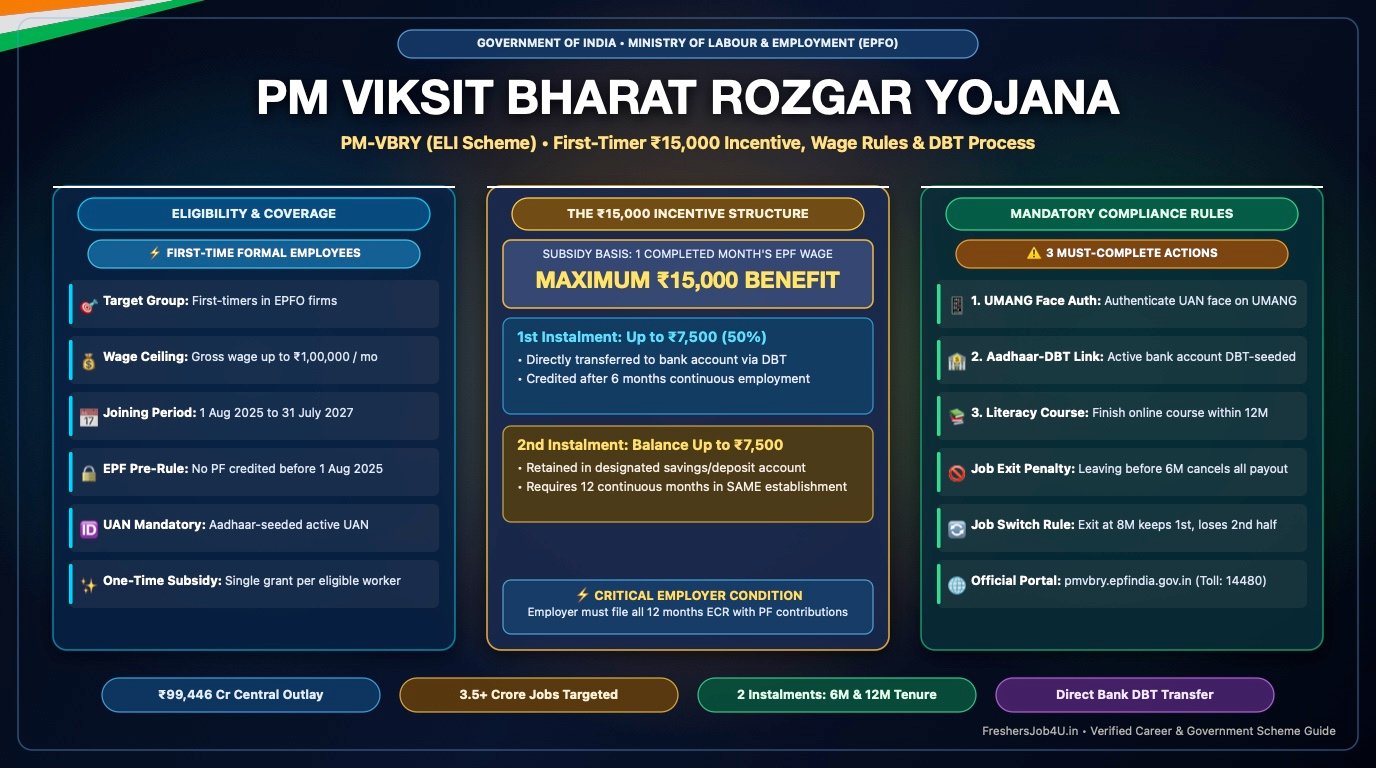
| Benefit | One completed month’s EPF wage, maximum ₹15,000 |
| Paid as | Two instalments — see the section below |
| Salary ceiling | Gross wage up to ₹1,00,000 per month |
| Jobs covered | Those starting between 1 August 2025 and 31 July 2027 |
| How many times | One-time incentive per eligible first timer |
| Total outlay | ₹99,446 crore, targeting 3.5+ crore jobs |
| Official portal | pmvbry.epfindia.gov.in |
| Helpline | 14480 / 1800-180-1850 |
The Money: What You Actually Receive, and When
This is where the scheme is most widely misreported, so here it is precisely, from EPFO’s own documentation.
The incentive equals one completed month’s EPF wage, subject to a maximum of ₹15,000. It is paid in two instalments:
| First instalment | Second instalment | |
|---|---|---|
| Amount | Up to ₹7,500 | The balance, up to ₹7,500 |
| When | After 6 months of continuous employment | After 12 completed months in the same establishment |
| Extra condition | — | You must complete the Financial Literacy Course |
| Where it goes | Your Aadhaar-seeded bank account, by DBT | A designated savings or deposit account, held for a period |
The part nobody tells you about the second instalment
EPFO’s official FAQ answers the question “How is the second instalment handled?” like this:
“The second instalment is held in a designated savings or deposit account for a period as specified in future guidelines issued by the Ministry of Labour & Employment.”
Read that carefully. The holding period is to be specified in future guidelines. That means, as things stand, nobody (not EPFO, not the Ministry) has published when you can actually withdraw the second half of your incentive. It is not lost, and it is yours; but anyone telling you confidently that you receive ₹15,000 in cash within a year is going beyond what the government has actually said.
Plan on this basis: up to ₹7,500 is real, spendable money in your bank account at the six-month mark. Treat the rest as savings you will get later, on a timetable not yet announced.
And it is EPF wage, not your salary
The second common error. The incentive is calculated on your EPF wage: defined as the wage on which provident fund contribution is paid under Section 6 of the EPF & MP Act, 1952, not on your gross salary or CTC.
Those are different numbers, and for most freshers the EPF wage is considerably lower than the gross. So a candidate earning ₹30,000 gross does not automatically get ₹15,000; they get one month of their EPF wage, capped at ₹15,000. If your EPF wage is ₹12,000, your total incentive is ₹12,000, not ₹15,000. The ₹1 lakh figure you see quoted is the eligibility ceiling on gross wage, not the basis of the calculation. Our Freshers In-Hand Salary Calculator is useful here, since working out your PF deduction tells you roughly what wage your contribution is being paid on.
Are You a “First Timer”? The Exact Definition
EPFO defines a First Timer as any employee:
- with a date of joining in an establishment between 01.08.2025 and 31.07.2027 (both dates inclusive), and
- who was not a contributing member of EPF, either with EPFO or an Exempted Trust, prior to 01.08.2025, and
- whose contribution is received in EPFO or an exempted trust for the first time for the wage month August 2025 or thereafter
Four things that quietly disqualify you
- Any EPF contribution before 1 August 2025. This is the big one. If you did a paid internship or a short job where PF was deducted (even for one month, even years ago) you are not a first timer. Check your PF history before assuming you qualify.
- Moving between an Exempted Trust and EPFO. EPFO states plainly that if you were previously a contributing member in an Exempted Trust and now join EPFO, or the other way round, you cannot qualify as a First Timer.
- Splitting your first year across employers. You must complete 6 months for the first instalment and 12 completed months in the same establishment for the second. Three months at one company and three at another does not add up to six for this purpose.
- A UAN that is not FAT-authenticated. See the next section. This one disqualifies more people than all the others combined.
One piece of good news: simply having a UAN does not disqualify you. EPFO confirms that if you have a UAN but never had contributions credited before the scheme’s start date, and your first contribution arrives during the scheme period, you are still a First Timer. A dormant UAN from a college-era formality is not a problem; a contribution is.
The Three Things That Will Stop Your Payment
In February 2026 the Ministry issued a public warning about compliance, and the three conditions below are the ones that actually decide whether money reaches you.
1. Your UAN must be verified by Face Authentication
EPFO’s position is unambiguous: “Only those with FAT authenticated UAN are eligible for benefits.” Face Authentication Technology verification of your Universal Account Number is mandatory, and the Ministry has stated that benefits will not be provided without this digital verification.
The FAT facility is provided on the UMANG app, which is also where you can generate your UAN directly if your employer has not done it. If the authentication fails for technical reasons, EPFO advises visiting your regional EPFO office rather than waiting.
Do this in your first week on the job. It is the single step most likely to cost someone their incentive, and it is entirely within your control.
2. Your bank account must be DBT-enabled
The money arrives by Direct Benefit Transfer into your Aadhaar-seeded account. An account that is merely linked to Aadhaar is not necessarily DBT-enabled: these are different things, and the Ministry has specifically instructed employees whose accounts are not DBT-enabled to contact their bank branch to activate the facility. Ask your bank directly; do not assume.
3. Your employer must file ECR properly — every month
This is the condition you cannot control, and it deserves more attention than it gets. The Electronic Challan-cum-Return (ECR) is the employer’s monthly online submission of PF contributions. For the second instalment, EPFO requires that all 12 months of ECR with contributions have been filed by the establishment.
The Ministry has warned that establishments which do not file ECR regularly, or which delay depositing contributions, may see their employees barred from the scheme’s benefits. In other words: your employer’s administrative sloppiness can cost you up to ₹15,000, and you will not be told.
Practical advice. Check your EPF passbook every couple of months on the EPFO member portal or UMANG. If contributions are missing or arriving late, raise it with your HR early rather than discovering the problem at the twelve-month mark.
What Happens If You Leave Your Job
EPFO answers this directly, and the rule is simple and strict:
- Leave before 6 months, voluntarily or otherwise — you are not eligible for the first instalment.
- Leave after 6 months but before 12 months: you keep the first instalment but are not eligible for the second.
There is no clawback of what has already been paid; you simply forfeit what has not. But the practical implication is worth stating plainly: if you are a first-time employee thinking about switching jobs at the ten-month mark, that decision now has a price tag of up to ₹7,500 attached to it. That should not be the deciding factor in a career move, but it belongs in the calculation.
The Joining-Date Detail Worth Knowing
Your six-month and twelve-month clocks run on “Completed Wage Months”, which EPFO defines as a full calendar month for which your employer has filed the ECR. The rule for your first month:
- Join on or before the 5th of a month → that month counts as your first Completed Wage Month
- Join after the 5th → the following month is your first Completed Wage Month
So joining on the 4th versus the 6th can shift your entire incentive timeline by a month. If you have any say over your joining date and it falls near the start of a month, this is a small, free optimisation.
The Financial Literacy Course
Completing this is a hard condition for the second instalment, not a suggestion. EPFO describes it as a mandatory online course covering personal finance, savings, investments and related topics, available on the EPFO website. It is free.
The scheme portal’s own guidance is to complete it before you reach 12 months of service, so that the second instalment is not held up. Do not leave it until month eleven.
How It Works, Step by Step
- Obtain your UAN: through your employer, or generate it yourself on the UMANG app using Face Authentication
- Get your UAN FAT-authenticated on UMANG. Without this you are ineligible, regardless of everything else
- Confirm your bank account is Aadhaar-seeded and DBT-enabled: check with your branch
- Work continuously, and keep an eye on your EPF passbook to confirm your employer is filing contributions each month
- At 6 months, the first instalment is credited to your bank account by DBT
- Complete the free Financial Literacy Course on the EPFO website before you hit 12 months
- At 12 completed months in the same establishment, the second instalment is released into a designated savings or deposit account
Note what is absent from that list: there is no application form for employees. You do not apply for PM-VBRY. Your employer registers on the portal, and your eligibility flows from your EPF record. Your job is to make sure the three conditions above are satisfied.
This is worth keeping in mind while you are still job-hunting rather than after you join. A first job at any large, EPFO-registered employer: a mass recruiter like TCS BPS, for instance, where thousands of commerce and science graduates enter the formal workforce each cycle: makes you a first-time EPFO member on day one, and the six-month clock starts whether you are paying attention to it or not.
Is the Scheme Actually Paying Out?
A fair question, and the answer is yes, with figures on record.
| Milestone | Figure |
|---|---|
| First-time employees formalised since Aug 2025 | Over 70 lakh |
| Share of beneficiaries who are women | Nearly 30% |
| Transferred directly to beneficiary bank accounts | Over ₹2,000 crore |
| Completed six months in their first job | Around 20 lakh |
| Already received incentives at that milestone | Around 10 lakh |
| March 2026 disbursement, Part A | ₹247 crore to 4.41 lakh first-time employees |
| March 2026 disbursement, Part B | ₹214 crore to 17,551 establishments |
| 19 June 2026 disbursement event | Around ₹2,400 crore, over 15 lakh beneficiaries |
Read the first two rows of that table together with the fifth and sixth. Roughly 20 lakh people have crossed six months, and about 10 lakh have been paid. That gap is not necessarily a failure, payments run in batches, but it is a reason to check your own compliance rather than assume the money will simply appear.
What About Part B?
Part B is the employer side, and you should know it exists because it explains why companies are motivated to register. Employers generating additional employment receive up to ₹3,000 per month per additional employee for two years, with manufacturing-sector employers eligible for an additional two years beyond that.
For you as a candidate this has one practical consequence: an employer who is registered and compliant under PM-VBRY has a financial reason to keep their ECR filings clean, which is exactly what your second instalment depends on.
PM-VBRY also sits alongside the government’s other employment infrastructure rather than replacing it. If you are still searching, registering on the National Career Service portal is a separate and free step. Our NCS portal registration guide covers that, and the two have nothing to do with each other administratively. PM-VBRY begins only once you are actually employed and contributing to PF.
Who This Guide Does Not Apply To
- Anyone who contributed to EPF before 1 August 2025: you are a re-joinee, not a first timer, and Part A is focused on first timers
- Workers in establishments not covered by EPFO: the scheme runs entirely on the EPF system
- Apprentices and trainees whose stipend does not attract PF. Apprenticeship training under NAPS and NATS works on a different basis entirely, with its own stipend rules: an apprenticeship is not a first job for PM-VBRY purposes unless PF contributions are actually being made
- Anyone earning above ₹1 lakh gross per month in their first job
Official Links
| Resource | Link |
|---|---|
| Official scheme portal | pmvbry.epfindia.gov.in |
| Guidance for first-time employees | PMVBRY for Employees |
| Official scheme guidelines | PM-VBRY Guidelines |
| Frequently Asked Questions | EPFO PM-VBRY FAQ |
| EPFO | epfindia.gov.in |
| Helpline | 14480 / 1800-180-1850 (toll free) |
Frequently Asked Questions
Q. Do I have to apply for PM Viksit Bharat Rozgar Yojana?
No. There is no employee application form. Employers register on the portal, and your eligibility is determined from your EPF record. What you must do is get your UAN authenticated by Face Authentication on the UMANG app, make sure your bank account is Aadhaar-seeded and DBT-enabled, and complete the Financial Literacy Course before twelve months.
Q. Will I actually receive ₹15,000 in cash?
Not all of it, and not quickly. The first instalment of up to ₹7,500 is credited to your bank account after six months of employment. The second is held in a designated savings or deposit account for a period that EPFO says will be specified in future guidelines, so the withdrawal timeline for that half has not yet been published.
Q. Is the incentive based on my salary or my EPF wage?
Your EPF wage: the wage on which your PF contribution is paid. It is capped at ₹15,000. The ₹1 lakh figure is the eligibility ceiling on gross monthly wage, not the basis of the calculation.
Q. I did a paid internship where PF was deducted. Am I still a first timer?
If that contribution was credited to EPFO or an exempted trust before 1 August 2025, then no. You do not meet the first-timer definition. Check your EPF passbook rather than guessing.
Q. I have a UAN but no contributions were ever made. Does that disqualify me?
No. EPFO confirms that if you have a UAN but no contributions were credited before the scheme’s start date, and your first contribution comes during the scheme period, you are still a First Timer.
Q. What if I change jobs after eight months?
You keep the first instalment but lose the second, because the second requires twelve completed months in the same establishment. Leaving before six months means you get nothing.
Q. My employer is late with PF contributions. Does that affect me?
Yes, and this is the risk you cannot control. The second instalment requires all twelve months of ECR with contributions to have been filed by your employer, and the Ministry has warned that employees of non-compliant establishments may be barred from benefits. Check your EPF passbook regularly and raise gaps with HR early.
Q. Until when is the scheme open?
Benefits apply to jobs created between 1 August 2025 and 31 July 2027. Your joining date must fall within that window.
Q. Can I get this incentive more than once?
No. EPFO describes it as a one-time incentive for eligible first timers.
Q. Is this the same as the ELI scheme?
Yes. The Union Cabinet approved the Employment Linked Incentive Scheme on 1 July 2025 and it was named the Pradhan Mantri Viksit Bharat Rozgar Yojana. The two names refer to the same scheme.
Source & Verification
- Scheme mechanics, definitions and conditions: official PM-VBRY portal run by EPFO: the Scheme, Guidelines, PMVBRY for Employees and Frequently Asked Questions pages, read directly on 6 October 2026
- Instalment split and savings instrument: PIB release, Ministry of Labour & Employment, Rajya Sabha reply by the Minister of State for Labour and Employment, December 2025
- Compliance requirements (Face Authentication, DBT, ECR): PIB release, Ministry of Labour & Employment, 25 February 2026
- Scheme performance figures: PIB release on the disbursement event of 19 June 2026 (Release ID 2275419)
- Cabinet approval, outlay and scheme period: Prime Minister’s Office and PM-VBRY Guidelines page
- Last Checked: 6 October 2026
For more guides of this kind, see our careers and schemes blog.
Disclaimer: FreshersJob4U is not affiliated with EPFO, the Ministry of Labour & Employment or the Government of India. This guide is informational and compiled from official government sources as they stood on the date noted above. The Ministry has stated that further guidelines on the second instalment are to be issued, and scheme conditions can change. Verify current rules on pmvbry.epfindia.gov.in before acting. No fee is payable to anyone to receive benefits under this scheme; treat any demand for payment as fraudulent.

Engineering graduate and founder of FreshersJob4U. I write detailed job guides, interview prep resources, and career roadmaps for freshers and early-career professionals in India. This site started from my own experience with the scattered, confusing fresher job search — I wanted to build something cleaner.