If you’ve been scrolling through government job and internship updates lately, you’ve probably come across the Prime Minister’s Internship Scheme — usually shortened to PM Internship Scheme, or PMIS. It’s one of the largest internship programmes the Indian government has ever run, and unlike a lot of “government internship” listings that turn out to be small, department-specific openings, this one is genuinely built to place lakhs of young Indians inside real private companies, doing real work, with a monthly stipend attached.
That said, the scheme has also changed meaningfully since it first launched — the eligibility rules were expanded as recently as April 2026, and a lot of articles still floating around online describe the older, narrower version of the scheme. This guide walks through what the PM Internship Scheme actually is, who can apply under the current rules, what you’ll actually receive if selected, and exactly how to get through the application and selection process — while being upfront about what’s still uncertain or varies round to round, rather than inventing precision that isn’t there.
One thing worth setting straight before anything else: this scheme offers real work exposure and a stipend, not a promised job. Nothing in the official design guarantees employment at the end of the internship, and this article won’t claim otherwise.
In This Guide
Table of Contents
What Is the Prime Minister’s Internship Scheme?
The Prime Minister’s Internship Scheme is a central government programme, administered by the Ministry of Corporate Affairs (MCA), that places eligible young Indians into paid, hands-on internships at some of the country’s largest companies. It isn’t run by an individual ministry’s own department the way a typical “government internship” is — instead, it works through a centralized online portal that connects candidates with private-sector companies willing to take on interns, with the government co-funding the stipend.
The scheme was announced in the 2024 Union Budget and launched as a pilot on October 3, 2024, with an initial target of 1.25 lakh internships in its first round. The stated long-term ambition is to provide internship opportunities to one crore (10 million) young people over five years, largely through India’s top companies by average corporate social responsibility (CSR) spending — CSR spend history is how eligible companies are identified for participation in the first place.
Why Was the PM Internship Scheme Launched?
The core problem the scheme is trying to address is a familiar one for anyone who’s job-hunted in India: a huge number of graduates and diploma holders complete their education every year with little to no exposure to how an actual workplace functions, which makes that first job search harder than it needs to be. Employers, on the other hand, often say entry-level hires need months of onboarding just to become productive, because classroom learning and real business operations don’t always line up.
PMIS is designed to sit in that gap — giving young people a structured, paid runway into real corporate environments before they’re expected to compete for full-time roles, while giving companies a low-risk way to evaluate and mentor early-career talent at scale. It’s also positioned alongside broader national priorities like the National Education Policy’s push for experiential, workplace-linked learning, rather than existing as a standalone, one-off scheme.
Key Highlights of the Scheme
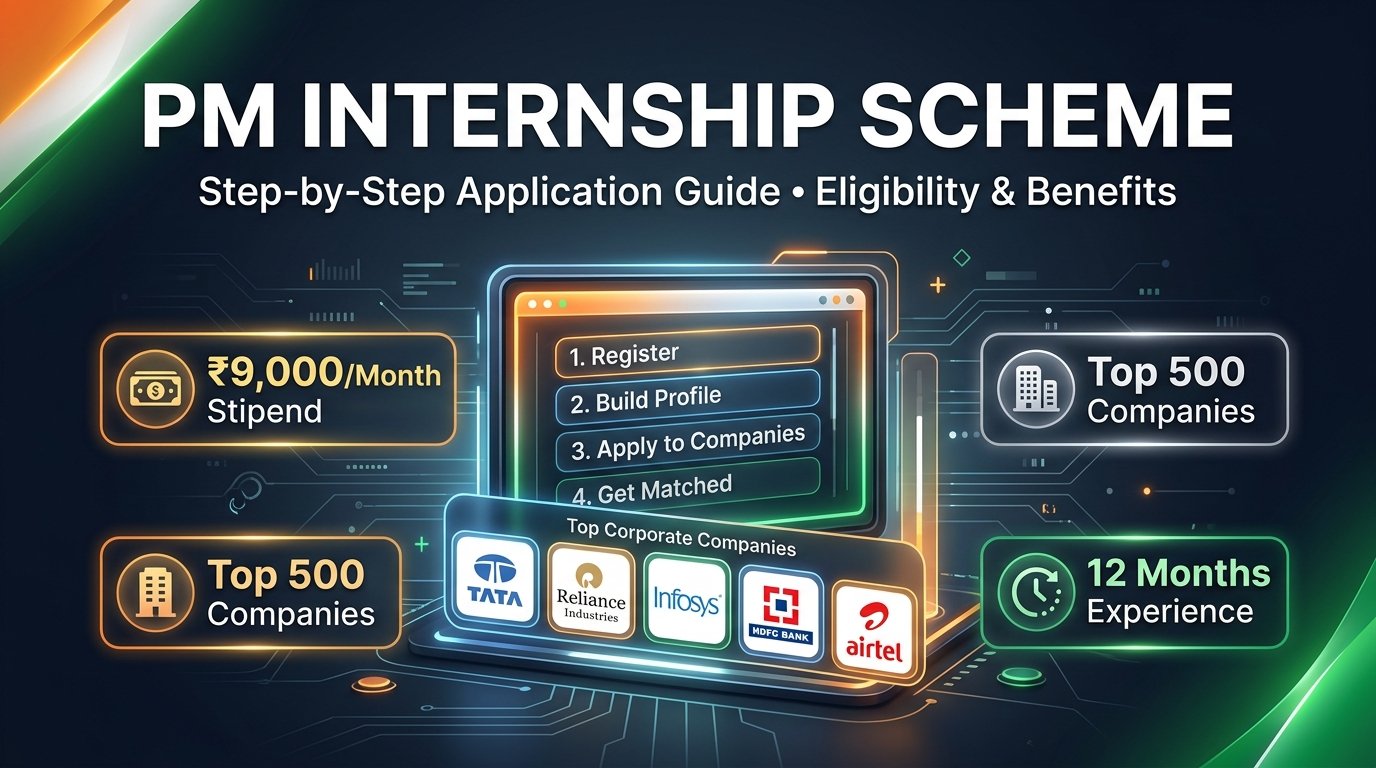
| Aspect | Detail |
|---|---|
| Administered by | Ministry of Corporate Affairs (MCA), Government of India |
| Pilot launched | October 3, 2024 |
| Long-term target | 1 crore (10 million) internships over 5 years |
| Current age limit | 18–25 years (expanded from 21–24 in April 2026) |
| Monthly stipend | Minimum ₹9,000 per month |
| One-time grant | ₹6,000 on joining |
| Standard duration | 12 months (see the Duration section for an important caveat) |
| Participating companies | 300+ and growing, identified largely by average CSR spend |
| Sectors covered | 20+ sectors including banking, energy, automotive, manufacturing, hospitality, and IT |
| Application cost | Free — no fee at any stage |
| Official website | pminternship.mca.gov.in |
Objectives
The scheme’s stated goals are fairly specific rather than vague “youth empowerment” language:
- Give young Indians real, paid exposure to at least one major business environment or industry before they enter the full-time job market
- Build employability skills that come specifically from workplace experience — things classroom learning alone doesn’t teach
- Widen access to internships at large, brand-name companies for candidates who wouldn’t otherwise get a foot in the door through personal networks or campus placement cells
- Give participating companies a structured pipeline for identifying and mentoring early-career talent, funded partly through their CSR obligations
- Do this at a scale — one crore internships over five years — large enough to meaningfully dent the country’s youth employability gap, not just serve a small pilot cohort
Eligibility Criteria
This is the section where it matters most to know which version of the rules you’re reading. The scheme’s eligibility was meaningfully expanded on April 22, 2026, and a lot of older articles (and some still-uncorrected ones) describe only the original, narrower pilot-phase rules. Here’s both, clearly separated.
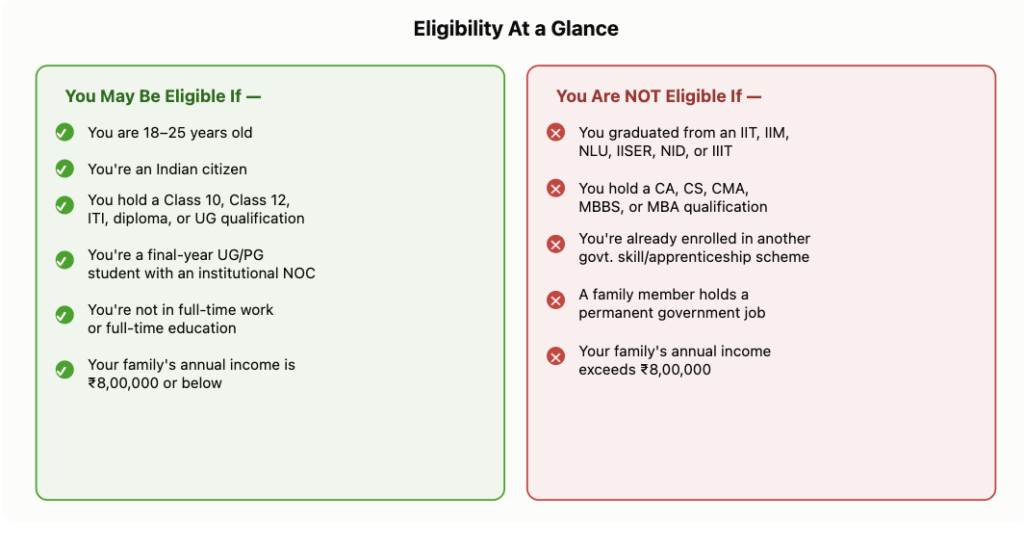
Current Eligibility (as of the April 2026 expansion)
| Criterion | Requirement |
|---|---|
| Age | 18 to 25 years, as of the application date |
| Citizenship | Indian citizens only |
| Education | Class 10 pass, Class 12 pass, ITI certificate, Polytechnic diploma, or an undergraduate degree — distance/online-mode qualifications are accepted too |
| Final-year students | Now eligible (this is the key change) — final-year undergraduate and postgraduate students can apply, provided they submit a No Objection Certificate (NOC) from their institution confirming the internship won’t interfere with their academics |
| Employment status | Not employed full-time and not enrolled in full-time education (final-year students are the specific exception, covered by the NOC requirement above) |
| Family income | Annual household income not exceeding ₹8,00,000 |
The NOC for final-year students needs to be signed by an authorised person at the institution — a Head of Department, Dean, Principal, or Training and Placement Officer. This is a real document requirement, not a formality you can skip, so if you’re applying as a final-year student, get this sorted with your college well before you plan to register.
Previous (Pilot-Phase) Eligibility — No Longer the Current Rule
For context, and so you’re not confused if you see this version referenced elsewhere: the scheme’s original pilot rounds (Round 1 and Round 2, running from October 2024 through early 2026) restricted the age band to 21–24 years and did not permit final-year students to apply at all — only candidates who had already completed their qualification and were not enrolled in any full-time programme were eligible. If you’re reading this after the article’s original publication and see conflicting age ranges elsewhere, the 18–25 band with final-year eligibility is the current, expanded rule as of the April 2026 announcement.
Who Cannot Apply?
Beyond the basic age, education, and income requirements, several specific categories of candidates are excluded — this list matters because these exclusions catch people out fairly often:
- Graduates of IITs, IIMs, National Law Universities, IISERs, NIDs, and IIITs
- Holders of professional qualifications such as Chartered Accountant (CA), Company Secretary (CS), Cost and Management Accountant (CMA/ICWA), MBBS, or MBA
- Candidates already enrolled in another government skill development or apprenticeship scheme
- Candidates from families where a member holds a permanent government position
- Candidates whose annual family income exceeds ₹8,00,000
The logic behind these exclusions is straightforward once you see it: the scheme is aimed specifically at candidates who don’t already have strong institutional or professional pathways into employment, so premier-institute graduates and professional degree holders — who typically have other, well-established routes into good jobs — are routed elsewhere.
Benefits and Financial Assistance
Here’s what a selected intern actually receives:
- Monthly stipend of at least ₹9,000, paid via Direct Benefit Transfer (DBT) straight into the intern’s bank account — this figure was increased from the original pilot-phase amount and is the current minimum as of the April 2026 update
- A one-time grant of ₹6,000 on joining, meant to help cover initial costs like relocation or setting up for the internship
- Insurance coverage under the Pradhan Mantri Jeevan Jyoti Bima Yojana (life insurance) and Pradhan Mantri Suraksha Bima Yojana (accident insurance) for the duration of the internship, with some host companies adding further accident cover on top
- A government-recognised completion certificate, issued as a QR-secured digital PDF through the portal once the internship and any required exit survey are completed
- Genuine work exposure at a large, established company — not a shadow role, but an actual placement within a business function
- No cost to apply or participate — registration, application, and participation are entirely free at every stage
Older sources describing the pilot phase mention a ₹5,000 monthly stipend split as ₹4,500 from the government and ₹500 from the host company. That was accurate for the original 2024 pilot rounds; the current minimum stands at ₹9,000, though the current government/company funding split hasn’t been clearly published in official communications at the time of writing — treat the ₹9,000 figure as the reliable current total, and don’t assume the old 4,500/500 split still applies without confirming it on your specific offer.
Internship Duration and Structure
The scheme’s original design set internships at 12 months, with at least 6 months of that meant to be genuinely hands-on work within the host company’s actual operations, rather than passive observation. This 12-month figure is what’s consistently reflected in official government sources and press material.
A handful of more recent secondary reports have referenced shorter placements — in the 6 to 9 month range — for some roles or rounds, framed as a way to move interns into the job market faster. This hasn’t been confirmed through an official government announcement as of this writing, so treat it as unverified rather than the current standard: if you’re offered a placement, check the exact duration stated in your specific offer letter rather than assuming either figure applies by default.
Participating Companies and Sectors
Companies aren’t just invited at random — participation is largely determined by a company’s average CSR (Corporate Social Responsibility) expenditure over the preceding three years, which is how the scheme identifies India’s largest, most established employers as internship hosts. Over 300 companies have taken part since the pilot began, spanning more than 20 sectors.
Illustrative sector-wise opening counts from a recent round (these numbers shift constantly as new opportunities are posted and filled, so treat them as a sense of scale rather than a live figure):
| Sector | Approximate Openings (illustrative, one recent round) |
|---|---|
| Oil, Gas & Energy | ~28,000 |
| Banking & Financial Services | ~18,500 |
| Travel & Hospitality | ~15,000 |
| Automotive | ~11,700 |
| Manufacturing, IT, Retail, and others | Openings vary continuously — check the live portal listing |
Because postings are continuous rather than a one-time batch release, the actual sector mix and opening count you’ll see on the portal on any given day will look different from this snapshot — this table exists to give you a sense of which sectors participate heavily, not a number to bank on.
How the Internship Actually Works
Once you’re placed, you work at the host company’s actual worksite (or remotely, if that specific role is structured that way), under that company’s day-to-day supervision — usually with a designated mentor or reporting manager. You’re expected to follow the host company’s working hours, code of conduct, and task assignments, much like a regular employee would, even though your stipend and certain administrative aspects (like the DBT stipend and insurance) are routed through the government scheme rather than the company’s standard payroll.
This is a meaningful distinction from a lot of “internship” arrangements: you’re not sitting in a training room learning generic material — you’re assigned to a real business function and given real, if appropriately scoped, work. The nature of the work itself depends entirely on which sector and role you’re placed in — a banking-sector placement will look very different day to day from one in manufacturing or hospitality.
How to Apply Online — Step-by-Step
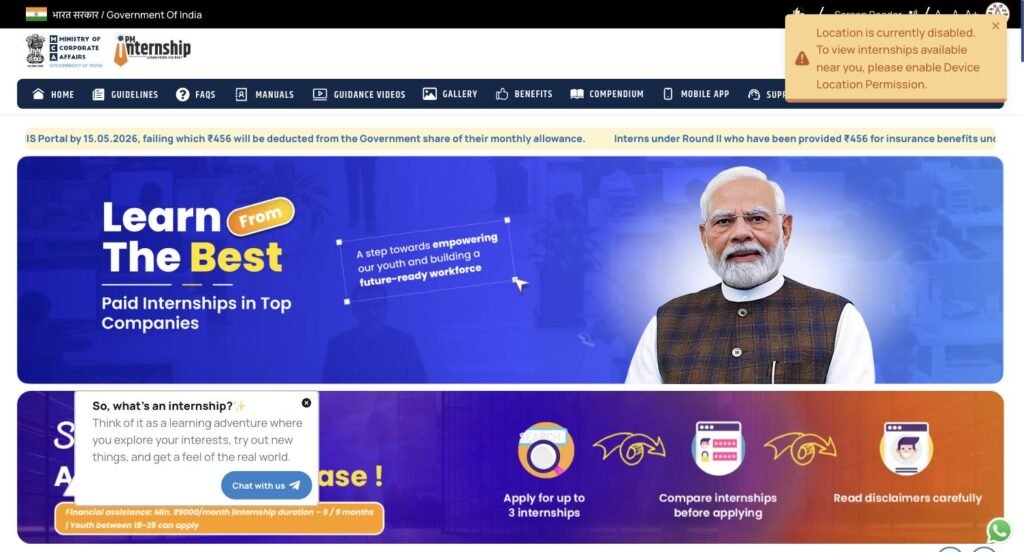
The entire process runs through the official portal at pminternship.mca.gov.in and costs nothing at any stage. Here’s the sequence:
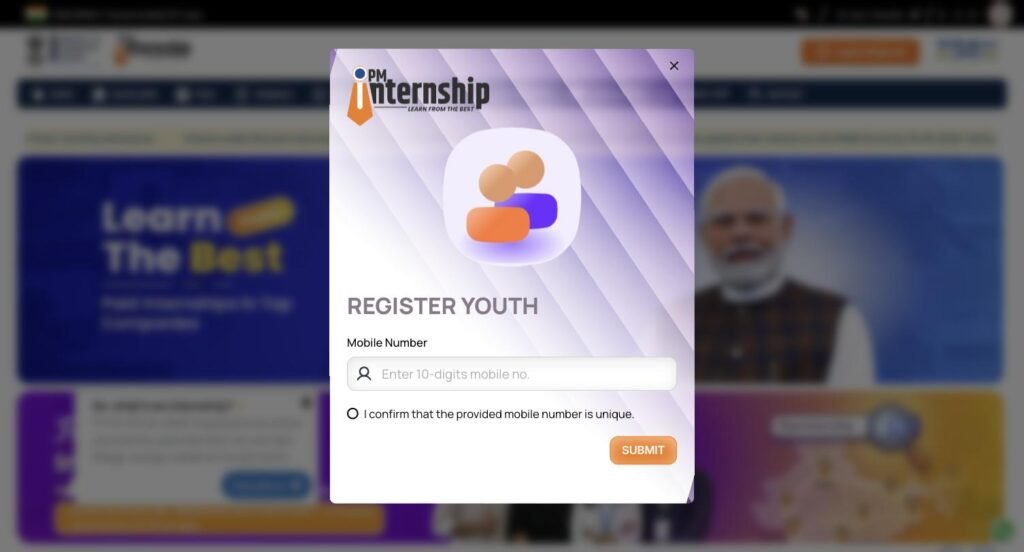
- Register on the portal using a mobile number linked to your Aadhaar. You’ll receive an OTP for verification — this step is mandatory and can’t be skipped or done with an unlinked number.
- Complete your e-KYC, which verifies your identity against your Aadhaar details.
- Fill in your profile — educational qualifications, skills, family income details, current address, and other personal information. The portal uses this to auto-generate a basic resume for you.
- Upload the required documents (see the next section) in the accepted format, usually PDF files under a specified size limit per document.
- Browse open internships by sector, role, and location, and select your preferences. There’s a cap on how many internships you can apply to in a given round — this number has varied between rounds, so check what your dashboard currently allows rather than assuming a fixed figure.
- Submit your application for your chosen internships and wait for the shortlisting outcome, which you’ll be able to track from your dashboard.
If you’re applying as a final-year student under the expanded eligibility rules, make sure your institution’s NOC is ready to upload alongside your other documents — don’t start the application assuming you can add it later.

Documents Required
Keep these ready before you start your application, since gathering them mid-application is the most common reason people abandon the process partway through:
- Aadhaar card (and a mobile number linked to it, for OTP-based registration)
- Latest educational qualification certificate/marksheet
- Family income declaration or certificate, to confirm you fall within the ₹8 lakh limit
- Bank account details, for the DBT stipend transfer
- A recent passport-size photograph
- For final-year students: the institutional No Objection Certificate (NOC), signed by an authorised official
Documents are typically uploaded as PDFs under a specified file-size limit per document — the exact limit is shown on the upload screen itself, so check it there rather than guessing before you scan or photograph your documents.
Selection and Internship Allocation Process
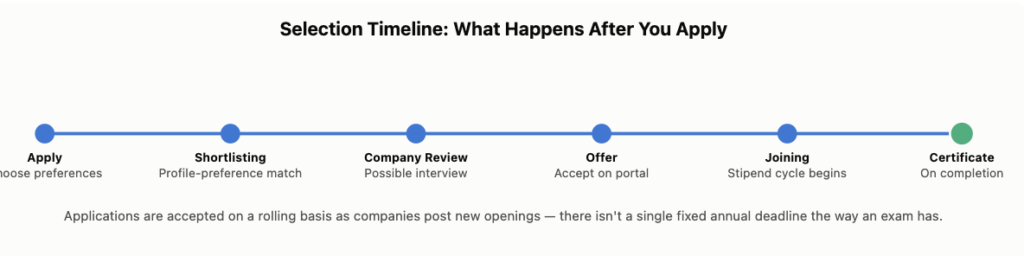
Once you’ve applied to your chosen internships, here’s roughly what happens next:
- Automated shortlisting: The portal matches your profile and stated preferences (sector, role, location) against what each participating company is looking for. There’s no entrance exam or aptitude test at this stage — it’s a preference and profile match, and the system also weighs representation for Scheduled Castes, Scheduled Tribes, Other Backward Classes, and Persons with Disabilities as part of shortlisting.
- Shortlist sent to companies: Roughly two to three times the number of actual available positions get shortlisted and passed on to each participating company, giving companies a genuine pool to choose from rather than a single forced match.
- Company-level review: The host company makes the final call. For some roles this is a straightforward profile review; for others, it may include a short interview or screening call, at the company’s discretion.
- Offer and acceptance: If selected, you’ll see an offer on your portal dashboard. You typically need to accept within a set window — don’t let this lapse if you intend to take the offer.
- Onboarding: Once accepted, you move to joining formalities with the host company, and your stipend cycle begins from your date of joining.
Because companies make the final selection based on their own criteria, meeting the government’s eligibility bar gets you into the shortlisting pool — it doesn’t by itself guarantee a company will select you over other shortlisted candidates.
Roles, Attendance, and Completion Requirements
As an intern, you’re expected to work under your host company’s direction — completing assigned tasks, following the reporting structure you’re given, and adhering to the company’s standard working hours and code of conduct. Regular attendance matters: since your stipend and eventual certificate are tied to actually completing the internship, extended unexplained absence can put both at risk, the same way it would in a regular job.
You’ll likely need to complete periodic check-ins or a self-declaration through the portal during your internship, and a closing survey at the end is typically required before your completion certificate is released. Treat these portal touchpoints as part of the internship’s actual requirements, not optional admin.
How to Check Your Application Status
Once you’ve applied, log back into your account on pminternship.mca.gov.in and go to your candidate dashboard — this is where the portal shows where your application currently stands (submitted, under review, shortlisted, or an outcome from the company). If you haven’t heard anything for a while, check your dashboard directly rather than assuming rejection, since profile screening and company review can take a few weeks depending on the volume of applications for that round.
Common Rejection Reasons and Mistakes to Avoid
Most rejections trace back to a handful of avoidable issues rather than bad luck:
- Mismatched or inaccurate personal details — your name, date of birth, or other details not matching across your Aadhaar, educational certificates, and application form is one of the most common causes of disqualification
- Incomplete profile or missing documents — an unfinished application, or one missing a required upload like the income declaration or (for final-year students) the NOC
- Not actually meeting eligibility — applying despite falling outside the age band, income limit, or being in an excluded category; the portal or the reviewing company will catch this even if the initial submission goes through
- Using unofficial third-party websites — a number of lookalike sites use “PM Internship Scheme” in their name or domain without being the actual government portal. Only pminternship.mca.gov.in is official; anything else asking for your details or, worse, a fee, should be treated with suspicion
- Last-minute, rushed applications — incomplete document uploads and typos are far more common when someone’s racing a perceived deadline instead of preparing documents in advance
- Weak preference selection — choosing only a narrow set of high-demand sectors or locations with no flexibility reduces your realistic shortlisting odds compared to a candidate with broader, still-genuine preferences
Career Benefits of the Scheme
Even without a guaranteed job at the end — and this scheme genuinely doesn’t promise one — completing a PMIS internship gives you something concrete to put on a resume: real time spent inside a large, recognisable company, in an actual business function, not a generic training programme. That’s a meaningfully different credential than most college-arranged internships, particularly for candidates who don’t have access to strong personal or campus networks that typically open doors at big companies.
Beyond the resume line, you walk away with a stipend earned during the internship, a certificate, some direct exposure to how a specific industry actually operates day to day, and — depending on how the internship goes — a genuine professional reference from your time there. Whether any of that converts into a subsequent job offer depends entirely on your own performance and the hiring needs of that company or others at the time, not on any guarantee built into the scheme itself.
Frequently Asked Questions
1. What is the current age limit for the PM Internship Scheme?
18 to 25 years, as of the eligibility expansion announced on April 22, 2026. The original pilot rounds had used a narrower 21–24 year band — if you see that older range elsewhere, it reflects the previous rules, not the current ones.
2. Can final-year students apply to the PM Internship Scheme?
Yes, as of the April 2026 expansion. Final-year undergraduate and postgraduate students can now apply, provided they submit a No Objection Certificate from their institution confirming the internship won’t interfere with their coursework.
3. What is the PM Internship Scheme stipend?
A minimum of ₹9,000 per month, paid via Direct Benefit Transfer, plus a one-time joining grant of ₹6,000. This is higher than the ₹5,000 figure some older articles still reference from the original 2024 pilot phase.
4. Is there a fee to apply for the PM Internship Scheme?
No. Registration and every stage of the application process are free. Any website or individual asking for payment to “process” your PMIS application is not part of the official scheme.
5. What is the official PM Internship Scheme website?
pminternship.mca.gov.in is the only official portal. A number of similarly named third-party websites exist and are not affiliated with the government — use them for general reading if you like, but always register and apply only through the official .gov.in domain.
6. Does the PM Internship Scheme guarantee a job after completion?
No. The scheme provides paid, structured work exposure and a completion certificate, not a guaranteed job offer. Some interns may go on to receive offers from their host company or elsewhere on the strength of the experience, but this isn’t built into the scheme as a guarantee.
7. Who is not eligible for the PM Internship Scheme?
Graduates of IITs, IIMs, NLUs, IISERs, NIDs, and IIITs; holders of professional qualifications like CA, CS, CMA, MBBS, or MBA; candidates already in another government skill or apprenticeship scheme; candidates with a family member in a permanent government job; and candidates whose family income exceeds ₹8,00,000 a year.
8. How many internships can I apply to in one round?
This cap has varied between rounds and isn’t consistently published as a fixed number across official sources — check your candidate dashboard after registering to see the current limit for the round you’re applying in, rather than relying on a specific number from any outside article.
Conclusion
The PM Internship Scheme is a genuinely large, genuinely funded programme — not a token government listing — and the April 2026 eligibility expansion has meaningfully widened who can apply, particularly by opening the door to final-year students for the first time. If you meet the current criteria, it’s a reasonable, cost-free way to get real exposure at a large company with a stipend attached, provided you go in with accurate expectations: it’s a structured internship with real selection competition, not an automatic placement, and not a guaranteed job. The most useful thing you can do before applying is get your documents in order — Aadhaar, education certificates, income declaration, and an NOC if you’re a final-year student — and register directly through pminternship.mca.gov.in rather than any third-party site.
This article reflects publicly available official government information, including Ministry of Corporate Affairs and PIB announcements, as of the article’s publication date. Scheme rules, stipend amounts, and eligibility criteria are set by the government and can change — always verify current details directly on pminternship.mca.gov.in before applying or making any decisions based on this article.

Engineering graduate and founder of FreshersJob4U. I write detailed job guides, interview prep resources, and career roadmaps for freshers and early-career professionals in India. This site started from my own experience with the scattered, confusing fresher job search — I wanted to build something cleaner.