Among the various government job opportunities in India, banking exams conducted by IBPS, SBI, and RBI are highly favored. Unlike other government exams that can take years to finalize, banking recruitments are completed within a structured timeline of 6 to 8 months.
Whether you are targeting the probationary officer (PO) or clerical cadre, a dedicated and strategic preparation plan can help you clear these competitive exams. With the right roadmap, cracking a bank exam in just six months is completely achievable for a fresher. If you are still deciding between the banking route and a wider public-sector career, it is worth comparing this against the entry pathways into PSU jobs, which run on very different recruitment cycles. achievable for a fresher.
This guide provides a detailed, month-by-month study plan, section-wise strategies, and the resource checklist you need to clear SBI, IBPS, or RRB bank exams on your first attempt.
Understanding the Exam Structure
Before diving into the study plan, you must understand the two main stages of banking recruitments:
Stage 1: Preliminary Exam (Qualifying)
This is a speed-based test designed to filter candidates. It features 100 questions to be solved in 60 minutes, split into three sections:
- Quantitative Aptitude (35 Qs / 35 Marks)
- Reasoning Ability (35 Qs / 35 Marks)
- English Language (30 Qs / 30 Marks)
Stage 2: Main Exam (Merit Scoring)
The Mains exam focuses on concept depth, data analysis, and general awareness. It is much longer (usually 2 to 3 hours) and includes:
- Data Analysis & Interpretation
- Reasoning & Computer Aptitude
- General, Economy, and Banking Awareness
- English Language
- Descriptive Writing (Essay & Letter for PO candidates)
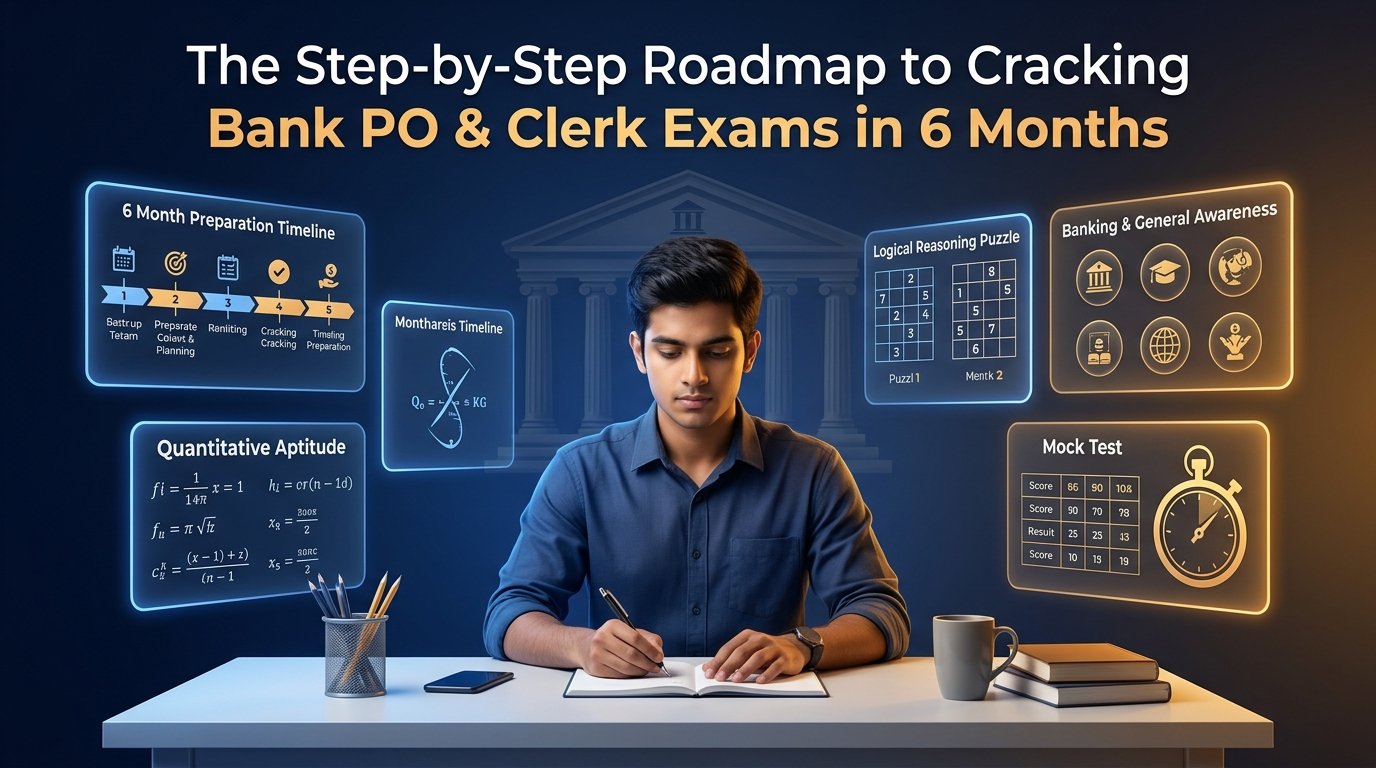
The 6-Month Month-by-Month Study Plan
Here is a structured, phase-wise timeline to take you from a absolute beginner to an exam-ready candidate.
Phase 1: Concept Building & Foundations (Months 1 & 2)
The first 60 days must be dedicated entirely to clearing your core concepts. Do not worry about speed right now; focus on understanding the logic behind the topics.
- Quantitative Aptitude: Memorize tables up to 30, squares up to 50, cubes up to 30, and fraction-to-percentage conversions. Master arithmetic topics: Percentage, Ratio & Proportion, Average, Profit & Loss, and Simple/Compound Interest.
- Reasoning Ability: Understand the rules of Syllogism, Inequality, Blood Relations, Coding-Decoding, and Direction Sense. Begin practicing simple linear and circular puzzles.
- English Language: Brush up on basic grammar rules (Tenses, Subject-Verb Agreement, Prepositions). Read an editorial page of a reputable daily newspaper (like The Hindu or The Indian Express) for 30 minutes daily to build vocabulary and reading speed.
Phase 2: Speed, Accuracy & Sectional Practice (Month 3)
Banking prelims are a race against the clock. Once you understand the concepts, you must learn to solve them quickly.
- Learn Shortcuts: Practice Vedic math tricks for fast calculation, approximation methods, and digital sum techniques.
- Topic-Wise Quizzes: Take daily 10-to-15 minute quizzes online for individual topics. Target solving Quadratic Equations, Number Series, and Simplification questions in under 30 seconds.
- Solve Puzzles Daily: Set a timer and practice solving 4 to 5 medium-level puzzles (Floor-based, Box-based, Scheduling) daily. Your target should be solving a prelims-level puzzle in under 3 minutes.
Phase 3: Transition to Mains Level & General Awareness (Month 4)
Many candidates make the mistake of studying for Mains only after clearing the Prelims. Because the gap between Prelims and Mains is usually only 20 to 30 days, you must start preparing for Mains in your fourth month of study.
- High-Level Data Interpretation (DI): Practice caselet DIs, missing number DIs, and arithmetic-based DIs.
- Critical Reasoning: Practice high-level puzzles with multiple variables, input-output machine questions, and coded inequalities.
- General & Banking Awareness: Start reading daily current affairs. Focus on banking and financial news, RBI circulars, government schemes, and financial terminology. Make it a habit to revise weekly current affairs.
Phase 4: Full-Length Mock Tests & Error Analysis (Month 5)
In the fifth month, mock tests should become your primary study tool.
- Take Full Mocks: Take 2 to 3 Prelims mock tests per week, simulating real exam conditions.
- Analyze Your Errors: Spend double the time analyzing your mocks. Identify which questions took the longest, which topics resulted in negative marks, and which questions you skipped. Maintain an “error notebook” to write down hard questions.
- Mains Mock Practice: Take 1 full-length Mains mock test every week to build stamina for sitting in a 3-hour exam.
Phase 5: Revision, Final Polish & Interview Prep (Month 6)
The final month is about consolidation and maintaining focus.
- Minimize New Topics: Do not start studying entirely new concepts. Strengthen what you already know.
- Daily Practice: Solve 20 Simplification questions, 5 DIs, 5 Puzzles, and 2 Reading Comprehensions daily to keep your mind sharp.
- Current Affairs Revision: Revise the last 4 to 6 months of current affairs thoroughly.
- Interview Prep (For PO): Practice basic banking terms (Repo rate, Inflation, NPA, KYC norms) and participate in mock interviews to build communication confidence. Almost every panel opens the same way, so it pays to rehearse how you answer “tell me about yourself” before you walk in.
Other Banking and Finance Routes Worth Tracking
PO and Clerk are not the only doors into the sector. Specialist Officer posts such as the IDBI Bank SO recruitment hire directly on domain qualifications rather than a general aptitude test, and many banking aspirants also sit adjacent finance-sector exams like the UPSC EPFO Assistant Provident Fund Commissioner recruitment. Keeping two or three of these cycles open at once meaningfully improves your odds within the same six months of study.
Recommended Preparation Checklist
To execute this roadmap successfully, leverage these standard resources:
- Quantitative Aptitude: Quantitative Aptitude for Competitive Examinations by R.S. Aggarwal.
- Reasoning Ability: A Modern Approach to Verbal & Non-Verbal Reasoning by R.S. Aggarwal, or online practice PDFs.
- English: Word Power Made Easy by Norman Lewis (for vocabulary) and Wren & Martin (for grammar).
- Mock Test Series: Testbook, Oliveboard, or PracticeMock (highly recommended for high-quality mock interface simulations).
Conclusion
Cracking a bank PO or Clerk exam is not about how many hours you sit at your desk, but how strategically you practice. By focusing on concept clarity in the first two months, transitioning to speed drills, and committing to extensive mock test analysis, you can comfortably secure a banking career within six months.
Stay consistent, track your progress week-by-week, and adjust your study plan based on your mock test analytics.

Engineering graduate and founder of FreshersJob4U. I write detailed job guides, interview prep resources, and career roadmaps for freshers and early-career professionals in India. This site started from my own experience with the scattered, confusing fresher job search — I wanted to build something cleaner.