TCS BPS is the route into Tata Consultancy Services that most people have heard of and almost nobody has had explained to them properly. It is a separate hiring stream from the engineering-focused TCS NQT process: different eligible degrees, a different and much shorter test, a different registration category on the same portal, and a genuinely different job at the end of it. Register under the wrong category and you cannot simply switch; you have to get the profile deleted and start again.
This guide covers the whole thing end to end: what the BPS business actually does, what you will do day to day, who can apply, the exam pattern and what to prepare, how the NextStep registration works, what the pay realistically looks like, and what happens after you join.
Table of Contents
What TCS BPS Actually Is
BPS stands for Business Process Services. It is the division of TCS that runs business operations for clients, rather than building software for them. Where the IT side writes and maintains applications, BPS runs the processes those applications support: the finance and accounting cycle, the insurance claim, the trade settlement, the customer query, the employee onboarding.
TCS has built formal academic curricula around this business, covering finance and accounting, banking, capital markets, retail and insurance, which tells you where the functional work concentrates. In practice, a BPS role will sit in one of a handful of broad areas:
- Finance and accounting: accounts payable and receivable, reconciliations, reporting cycles
- Banking and capital markets: transaction processing, trade and settlement operations, compliance checks
- Insurance: policy administration, claims processing, underwriting support
- Customer experience and service operations: handling customer interactions across voice, chat and email
- HR and back-office operations for client organisations
Increasingly, a meaningful part of the work is sitting alongside automation: identifying which steps in a process can be automated, checking the output of systems that do the routine work, and handling the exceptions those systems cannot. That is worth knowing, because it is the part of a BPS role that builds skills which travel.
So what is the work of BPS in TCS, day to day?
Honestly: it is operations. You own a defined process, you execute it against a service-level target, and you are measured on accuracy and turnaround. Depending on the account you are assigned to, a day may involve processing a queue of transactions, resolving exceptions that do not fit the standard flow, updating client systems, producing reports, and joining the daily huddle where the team’s numbers are reviewed.
It is structured, target-driven work, and whether that appeals to you is the single most important question in this entire guide. Some people find the clarity of it satisfying. You know exactly what good looks like. Others find it repetitive. Neither reaction is wrong, but it is far better to work out which one you are before you accept an offer than six months after.
BPS vs the IT Track (NQT): the Comparison Nobody Gives You
This is the most common point of confusion, so here it is side by side. The NQT figures are TCS’s own published bands.
| TCS BPS | TCS NQT (IT track) | |
|---|---|---|
| Who it is for | Commerce, arts, science, management and hospitality graduates | B.Tech, B.E, M.Tech, M.E, MCA, M.Sc/M.S |
| Degree length | Three-year full-time undergraduate degrees | Engineering and postgraduate technical degrees |
| Registration category | BPS on NextStep | IT on NextStep |
| Test length | Around 65 minutes, in-centre | A longer, multi-section assessment — see our NQT guide |
| Coding in the test | No | Yes |
| Published CTC (freshers, 0–1 year) | Not disclosed in the notification | TCS publishes Digital at 7.09–7.30 LPA (UG) and Prime at 9.09–9.30 LPA (UG) |
| Work | Business process operations | Software development, support and integration |
| Shifts | 24×7 environment, rotational including nights | Usually project-dependent, less uniformly shift-based |
Two things fall out of that table. First, these are genuinely separate processes: applying to one is not applying to the other, and TCS treats the registration categories as mutually exclusive. Second, if you hold an engineering degree, BPS is almost certainly not the stream you want; the NQT route leads to cadres with published CTC bands and a technical job. Our complete TCS NQT guide covers that side in detail, including the cadres and the test structure.
Equally, if you hold a BCom, BA or BSc, BPS is one of very few routes into a company of this size that is actually open to you, and that is the honest case for it.
Eligibility: Who Can Apply
Each hiring cycle publishes its own criteria, but the shape has been consistent. TCS states the rule as three-year full-time graduates from a defined list of degrees, restricted to a single year of passing. The list as published for the most recent cycle:
| Degree group | Degrees accepted |
|---|---|
| Commerce, arts and management degrees | BCom, BA, BAF, BBI, BBA, BBE, BFM, BHRM, BIBF, BBM, BMS |
| BSc specialisations | Maths, Physics, Chemistry, Botany, Biology, Zoology, Life Sciences, Biochemistry, Biotechnology, Microbiology, Environmental Science, Geology, Hospitality, Tourism Management |
Note that hospitality and tourism management appear as BSc specialisations in TCS’s own list rather than as a separate stream, which matters if you are checking whether your exact degree title qualifies.
The conditions that actually disqualify people
- Part-time and correspondence degrees are not accepted, whatever the stream. This is the single most common disqualification.
- One backlog is permitted at the time of the selection process, but it must be cleared within your university’s normal timeline. If clearing it pushes you past the standard graduation window, you become ineligible to join even if you were selected.
- Academic gaps of up to 24 months in total are acceptable, but must be declared in the application. An undeclared gap found later can end your candidature, so there is nothing to gain by leaving the field blank.
- NIOS-completed Class 10 or 12 is accepted, provided your subsequent education was full-time. A lot of candidates rule themselves out over this unnecessarily.
- Age must fall between 18 and 28: TCS states a minimum of 18 and a maximum of 28.
- The role is a trainee requirement only. TCS states this explicitly, and also requires any prior work experience to be declared in the application form even though the opening is for freshers.
Treat all of the above as the pattern rather than a guarantee: always read the current cycle’s own notification, since TCS republishes these conditions with each drive.
TCS BPS Exam Pattern and Syllabus
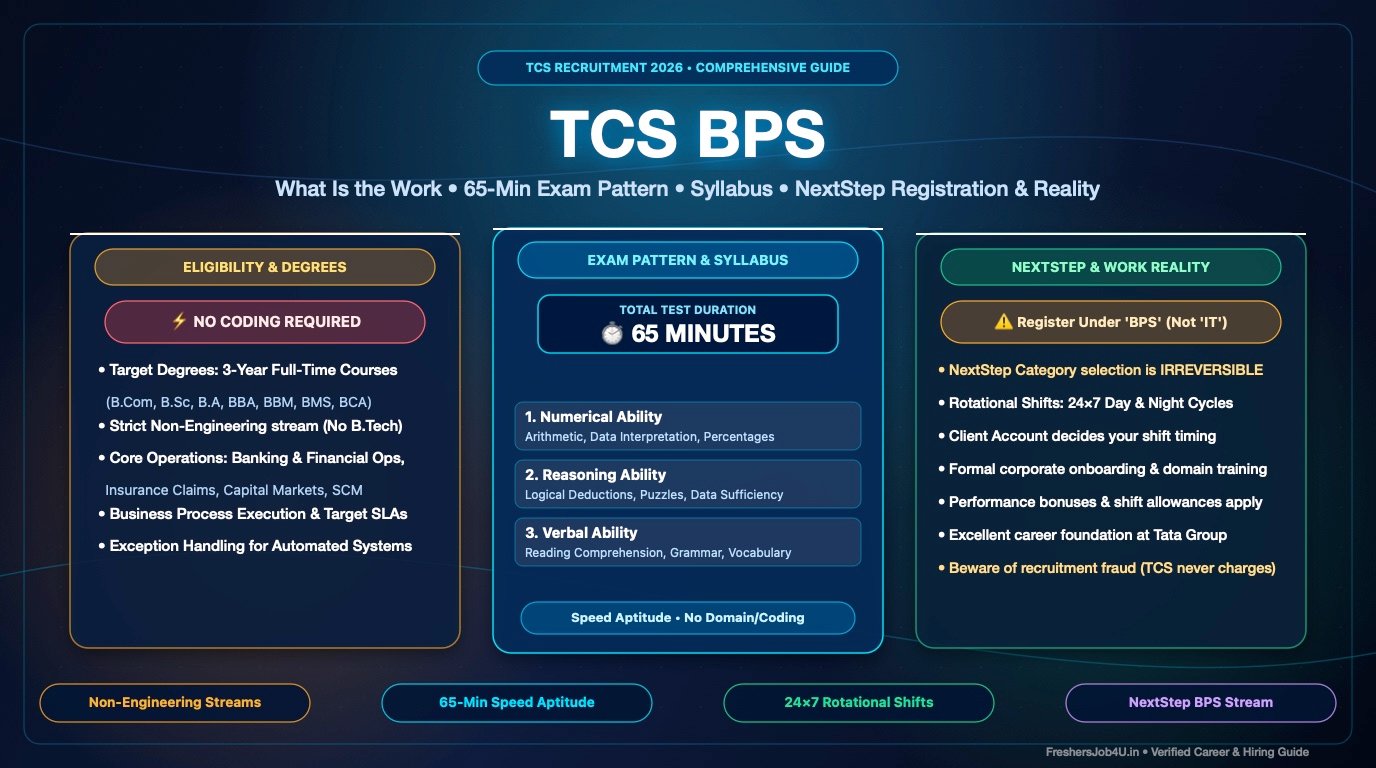
The BPS assessment is short and, importantly, contains no coding. Based on the most recent drive, it runs about 65 minutes in total, taken in-centre at a test venue you choose during the application, and that choice is locked once you submit, so pick on the basis of where you can realistically travel, not just the nearest name on the list.
| Element | Detail |
|---|---|
| Duration | Approximately 65 minutes |
| Sections | Verbal Ability, Numerical Ability, Logical Reasoning |
| Mode | In-centre (not from home) |
| Coding section | None |
| Technical / domain questions | None listed |
What to actually prepare
A word of caution first. TCS does not publish a detailed topic-level syllabus for the BPS test, so any site presenting one as official is filling in gaps. What follows is the standard content of an aptitude assessment of this structure and length: reliable as a preparation guide, but not a published TCS syllabus.
Verbal Ability: reading comprehension, sentence correction and error spotting, synonyms and antonyms, sentence completion, para-jumbles. Given that much BPS work involves written client communication, expect grammar and comprehension to carry real weight rather than being a formality.
Numerical Ability: percentages, ratio and proportion, profit and loss, averages, simple and compound interest, time and work, time speed and distance, number series, and basic data interpretation from tables and charts. This is school-level arithmetic applied under time pressure, not advanced mathematics.
Logical Reasoning: series completion, coding-decoding, blood relations, directions, seating arrangement, syllogisms, statement and conclusion, and simple puzzles.
How to prepare, given 65 minutes
The thing that decides this test is speed, not depth. With roughly an hour across three sections, you do not have time to derive anything from first principles. Three practical points:
- Drill the arithmetic until it is automatic. Percentage and ratio conversions, multiplication tables up to 20, squares and cubes, common fractions as decimals. Every second you save here is a second available for a question you actually need to think about.
- Practise with a timer from day one. Untimed practice teaches you that you can solve the questions, which is not the thing being tested.
- Do not leave verbal to chance. Candidates from non-English-medium backgrounds often focus entirely on quant and reasoning and then lose the section that is most straightforward to improve: reading comprehension rewards practice more reliably than anything else on this paper.
One practical shortcut: the aptitude portion of the TCS NQT assessment covers the same three ability areas, so NQT aptitude material transfers directly to the BPS test. You simply ignore the coding and advanced quantitative content. Given how much more NQT preparation material exists, that is a legitimate way to practise for BPS.
TCS NextStep: How BPS Registration Works
NextStep is TCS’s candidate portal, and it is where every BPS application begins. The steps below reflect the most recent drive; the portal itself stays consistent between cycles.
- Open the TCS NextStep portal and choose Register Now.
- Select the category as BPS, not IT. This is the decision that cannot be undone casually: a profile registered under the wrong category has to be deleted by the helpdesk before you can register again under the right one.
- Complete registration to generate your reference ID, known as the DT number. Keep it; everything afterwards is tracked against it.
- Log back in and fill the full application form. Your name and date of birth must match your Aadhaar exactly: these fields cannot be edited later.
- Submit the form, then click Apply for Drive. Filling the form is not applying; people miss this and assume they are done.
- Choose In-centre as the test mode and select your test centre. This cannot be changed afterwards.
- Open Track Your Application and confirm the status reads “Applied for Drive”. If it says anything else, you are not in the drive.
One portal detail worth knowing before it costs you a day: repeated OTP failures lock the account. Three failed attempts locks it for four hours, and further failures can lock it until the next day. Use a laptop with an updated browser rather than fighting the form on a phone.
Salary: What Is Actually Known
Let us be straight about this, because it is where most articles invent a number.
TCS publishes no salary, CTC, stipend or package figure anywhere on its official BPS hiring page: not in the eligibility criteria, not in the test pattern, and not across its full list of candidate FAQs. Nor does it mention any bond or service agreement. Self-reported figures circulate on salary-aggregator sites, but they are unverified, inconsistent between sources and based on small samples, so we are not going to repeat them as fact. The only number that means anything is the one in your offer letter.
What you can reason about is the structure. TCS does publish CTC bands for its IT-track cadres (for freshers with 0–1 year of experience, Digital is listed at 7.09–7.30 LPA and Prime at 9.09–9.30 LPA for undergraduates) and BPS entry-level pay sits well below those. That is the trade-off being made: BPS opens a door to a company of this scale for degrees the IT track does not accept, and the entry pay reflects it. TCS does not publish a BPS figure to put beside them, so anyone quoting one precisely is estimating.
Three things worth asking about explicitly when an offer is on the table, because they move the real number more than the headline CTC does:
- The fixed-versus-variable split. A CTC with a large variable component is not the same as the equivalent fixed salary.
- Shift allowance. In a 24×7 operation this is not a rounding error: night and rotational shift allowances can be a meaningful part of monthly take-home, and they are frequently left out when candidates compare a BPS offer against a day-shift offer on CTC alone.
- What actually reaches your account after PF and tax. Our Freshers In-Hand Salary Calculator converts a CTC into a realistic monthly take-home, which is the only basis on which two offers can honestly be compared.
Shifts and the Working Reality
BPS is a 24×7 operations environment, because the clients being supported sit across time zones. Rotational shifts, including night shifts, are a firm condition of the role rather than an occasional possibility, and your specific shift depends on the account you are assigned to, which is decided after you join, not before.
Do not treat this as fine print. Night-shift work has real effects on sleep, health and social life, and the people who struggle most in BPS are usually the ones who accepted the shift clause without thinking about it. If you know that rotational nights would not work for you, that is a legitimate reason to not apply, and a far better outcome than resigning in month four.
On where you will be posted: TCS states that your joining location is discussed during the interview process and that your location preference is taken into consideration, but the final assignment rests with TCS. Treat a preference as a preference, not a commitment, and factor relocation into your decision before you accept.
What Happens After You Join: the Real Next Step
Joining is the start of a path that is less discussed than the entrance exam, so here is an honest view of it.
You join as a trainee, go through onboarding and process training for the account you are mapped to, and then move onto live work under supervision before owning a queue independently. Progression inside BPS runs through process expertise: becoming the person who handles the hardest exceptions, then taking responsibility for quality checks, then for a small team.
On moving from BPS to the IT side: this is the question every BPS candidate asks, and the honest answer is that TCS does not publish a public policy on it, so anyone describing a guaranteed route is speculating. Internal mobility exists at TCS as it does at most large employers, but you should not join BPS on the assumption that you will transfer out of it. Join because the BPS career itself is one you want. If a move later becomes possible, treat it as something you would have to earn through qualifications, internal openings and performance, not as a scheduled next step.
The more reliable way to build optionality is inside the work itself: get deep in a domain such as finance and accounting, banking operations or insurance, add a recognised domain certification, and move toward the parts of BPS that touch automation, analytics and process improvement. Domain expertise plus comfort with the tooling is a combination that travels well, both inside TCS and outside it.
Who Should Apply — and Who Should Not
Worth applying if
- You hold a three-year full-time commerce, arts, science, management or hospitality degree and have found most large-company hiring closed to your stream
- You want a structured corporate start with formal training, a defined process and a recognisable name on your CV
- You are genuinely willing to work rotational shifts including nights
- You are interested in a business domain (finance, banking, insurance, retail) rather than in writing software
- You are comfortable with target-driven, measured work where accuracy matters more than invention
Think again if
- You hold an engineering or MCA degree: the NQT route is built for you and pays on published bands
- You are applying mainly as a way to get into TCS and move to the IT side later
- Rotational night shifts are not something you can sustain
- Your degree is part-time or by correspondence, in which case you are not eligible regardless of how well you would do the job
- You are weighing this against a government career and value security and fixed hours above brand and scale. Our comparison of a PSU versus private sector career for freshers sets out that trade-off properly
Preparing for the Interview Stage
Clearing the aptitude test gets you to an interview, and for a BPS role the questions are rarely technical. Expect to be asked why BPS specifically, whether you understand that it is operations work, how you handle repetitive tasks and pressure, whether you are genuinely comfortable with shifts, and some assessment of your spoken English and communication, which matters directly in client-facing process work.
Have a clear, non-defensive answer ready for “why BPS and not something in your own subject”, because it is coming. Our guide to common HR interview questions for freshers covers the general ground, and since this is a non-software role, our ATS-friendly resume guide is the right one to use rather than a developer-format template.
For wider context on where this sits in the current market, our analysis of fresher hiring trends in Indian tech is worth reading alongside this, and you can browse everything else currently open in our IT & Private Sector Jobs section.
Fraud Warning
TCS has stated that it does not send offers from personal email domains such as Gmail, Yahoo, Hotmail or Rediffmail, that it charges no fee at any stage of recruitment, and that it has no affiliated agents conducting interviews on its behalf. Treat any communication outside the official NextStep portal and TCS email domains as suspect, and never pay anyone for a referral, a test slot or an offer letter.
Frequently Asked Questions
Q. What is the work of BPS in TCS?
Business Process Services runs business operations on behalf of TCS’s clients rather than building software. Day to day that means executing a defined process against accuracy and turnaround targets (transaction processing, finance and accounting cycles, claims and policy work, trade operations, or customer interactions) along with handling the exceptions that automated systems cannot.
Q. Is TCS BPS the same as TCS NQT?
No. They are separate hiring streams with separate registration categories on NextStep, different eligible degrees, and completely different tests. NQT is the engineering and postgraduate technical route with a 190-minute test including coding; BPS is open to three-year degrees and uses a roughly 65-minute aptitude test with no coding.
Q. Can B.Tech graduates apply for TCS BPS?
BPS drives are aimed at three-year full-time undergraduate degrees in commerce, arts, science, management and hospitality. An engineering graduate should be looking at the NQT process, which accepts those degrees and carries published pay bands.
Q. What is the TCS BPS syllabus?
TCS does not publish a topic-level syllabus. The test covers Verbal Ability, Numerical Ability and Logical Reasoning in about 65 minutes, with no coding or domain questions. Prepare standard aptitude content for those three areas (comprehension and grammar, arithmetic and data interpretation, and reasoning) with a strong emphasis on speed.
Q. Is there coding in the TCS BPS test?
No. The BPS assessment is an aptitude screen only. Coding belongs to the NQT assessment, which is the separate IT-track process.
Q. Should I register under BPS or IT on NextStep?
BPS, if you are applying to a BPS drive. The categories are not interchangeable. If you have already registered under IT by mistake, you will need to contact the helpdesk to have that profile deleted before creating a new one under BPS.
Q. What is the salary for a TCS BPS fresher?
TCS does not disclose a figure in its BPS notifications, and no reliable published number exists. For scale, TCS does publish its IT-track fresher bands, Digital at 7.09–7.30 LPA and Prime at 9.09–9.30 LPA for undergraduates with 0–1 year of experience, and BPS entry pay sits well below those. Confirm your actual CTC, its fixed-versus-variable split, and the shift allowance in writing before accepting.
Q. Are night shifts compulsory in TCS BPS?
BPS is a 24×7 operations environment and rotational shifts including nights are a stated condition of the role. Your specific shift depends on the client account you are assigned to, which is decided after joining rather than before.
Q. Can I move from TCS BPS to the IT side later?
TCS does not publish a public policy on this, so treat confident claims about a guaranteed route with scepticism. Internal mobility exists, but you should join BPS for the BPS career rather than as a planned stepping stone, and treat any later move as something to be earned.
Q. Is TCS BPS a good place to start a career?
For a commerce, arts or science graduate it is one of the few structured entry points into an employer of this size, with formal training and a real domain to build on. It is a poor fit if you want technical work, cannot do rotational nights, or are counting on an early transfer out of the division. Both of those statements are true at the same time, and which one matters more depends entirely on you.
Source & Verification
- NQT published CTC bands (Prime and Digital, by experience and UG/PG): TCS All India NQT Hiring page, tcs.com
- BPS eligibility, test pattern, registration steps, shift and location conditions: official TCS BPS Hiring page on tcs.com: Test Pattern, Eligibility Criteria and Frequently Asked Questions sections
- Cycle-specific dates and deadlines: our TCS BPS Hiring 2027 page
- BPS functional domains: TCS’s own published Business Process Services curriculum areas: finance and accounting, banking, capital markets, retail and insurance
- Application portal: TCS NextStep
- Last Checked: 5 October 2026
Disclaimer: FreshersJob4U is not affiliated with Tata Consultancy Services. This guide is informational and compiled from official TCS sources and published drive notifications as they stood on the date noted above. Eligibility conditions, test patterns and compensation are set by TCS and change between hiring cycles: always verify the current criteria on the official TCS NextStep portal and the drive notification before applying.

Engineering graduate and founder of FreshersJob4U. I write detailed job guides, interview prep resources, and career roadmaps for freshers and early-career professionals in India. This site started from my own experience with the scattered, confusing fresher job search — I wanted to build something cleaner.