If you are an ITI pass-out, a 10th or 12th pass candidate, a diploma holder or a graduate looking for paid on-the-job training, the National Apprenticeship Promotion Scheme is the largest formal route into it in India. As of 7 September 2026, the official portal shows 1.65 crore registered candidates, 1.96 lakh registered establishments and roughly 6.98 lakh active vacancies. Registration is free, entirely online, and takes about ten minutes for the account itself.
Before you start, two things are worth clearing up, because most of the guides circulating online get both wrong. First, the scheme people search for as “NAPS 2.0” is officially written NAPS-2 — the second phase of the National Apprenticeship Promotion Scheme, running since 2022-23. Second, NAPS is not NATS. They are separate schemes, run by different ministries, on different portals, for different candidates — and applying on the wrong one is the single most common mistake we see. There is a section below that settles which one is yours.
This guide is built from the live portal as it stands today, with screenshots of the current interface, and from official MSDE and PIB sources. Where a figure is a recommendation rather than a notified rate, we say so rather than presenting it as settled. If you are a graduate or diploma engineer, you may actually need our step-by-step guide to NATS 2.0 registration instead — check the comparison table first.
Important: Check the Scheme’s Current Validity Before You Plan Around It
This is the most time-sensitive fact on this page, and it is not in any of the aggregator articles. MSDE Office Memorandum No. AP-15012/5/2020-AP, dated 23 April 2026, records that the version of NAPS-2 implemented during the 15th Finance Commission period concluded on 31 March 2026, and grants an interim extension pending completion of the appraisal and approval process for continuation in the 16th Finance Commission cycle — specifically, “Continuation of National Apprenticeship Promotion Scheme (NAPS-2) up to 30.09.2026”. NAPS-2 is one of three components of the composite Central Sector Scheme “Skill India Programme”, alongside PMKVY 4.0 and the Jan Shikshan Sansthan scheme.
Read that carefully, because it is easy to over-interpret in either direction. It does not mean apprenticeships stop on 30 September 2026 — the Apprentices Act, 1961 is permanent law, employers will keep engaging apprentices, and the portal will keep running. What it means is that the government’s financial support component under NAPS-2 is currently sanctioned only up to that date, with a longer continuation still going through appraisal. Schemes in this position are routinely extended, and there is no indication of discontinuation — but if your decision depends on the stipend-support element specifically, check the portal’s Office Memorandum section for a fresh extension order rather than assuming.
Registering now is still the right move. Your candidate account, profile and applications are not tied to that date.
Quick Facts
| Parameter | Details |
|---|---|
| Scheme | National Apprenticeship Promotion Scheme, Phase 2 (NAPS-2, commonly searched as “NAPS 2.0”) |
| Ministry | Ministry of Skill Development & Entrepreneurship (MSDE), Government of India |
| Official Portal | apprenticeshipindia.gov.in |
| Governing Law | Apprentices Act, 1961 |
| Launched | NAPS in August 2016; continued as NAPS-2 from 2022-23 |
| Registration Fee | None — registration is free for candidates |
| Minimum Age | 14 years; 18 years for hazardous industries |
| Government Stipend Support | 25% of the prescribed minimum stipend, capped at ₹1,500 per month per apprentice, paid by DBT directly to the apprentice — first-time training only |
| Apprenticeship Duration | 6 to 36 months, depending on the trade |
| Lifetime Limit | Maximum 2 apprenticeship trainings; the second must be in a different trade, with a minimum 1-year gap |
| Current Scheme Sanction | Extended up to 30 September 2026 pending 16th Finance Commission appraisal |
NAPS or NATS? Settle This First
Both are national apprenticeship schemes. Both pay a stipend. They are not interchangeable, and each has its own portal and its own registration.
| NAPS (NAPS-2 / “NAPS 2.0”) | NATS (NATS 2.0) | |
|---|---|---|
| Full name | National Apprenticeship Promotion Scheme | National Apprenticeship Training Scheme |
| Ministry | Skill Development & Entrepreneurship (MSDE) | Education |
| Portal | apprenticeshipindia.gov.in | nats.education.gov.in |
| Mainly for | ITI pass-outs, school pass-outs, and candidates in designated and optional trades across manufacturing and services | Graduate, diploma and technician (vocational) apprentices — typically engineering, technology and management streams |
| Administered through | DGT and Sector Skill Councils | Boards of Apprenticeship / Practical Training (BOAT/BOPT) |
The important 2026 change: a notice now running across the top of the apprenticeship portal states that NAPS and NATS are integrated for real-time contract eligibility checks, and that de-duplication and mandatory training-gap requirements are validated at key stages of the apprenticeship lifecycle. In practice this means you can no longer hold overlapping apprenticeship contracts across the two schemes, and the system will catch it. If you have previously done an apprenticeship under either scheme, expect the portal to check it.
Graduates and diploma engineers are usually on the NATS side — our NATS 2.0 registration guide covers that portal’s Aadhaar e-KYC and bank-seeding steps in the same detail as this one.
Who Can Register Under NAPS
- Minimum age: 14 years completed. For hazardous industries, the minimum is 18 years. You can check your exact age eligibility using our free Age Calculator Tool
- Minimum education: For optional trades, a 5th class pass is the floor. For designated trades, the qualification is whatever the notified curriculum for that trade prescribes — commonly 8th, 10th or 12th pass, or an ITI certificate in the relevant trade.
- Aadhaar: Required, and it needs to be linked to your bank account. The government’s share of the stipend is paid by Direct Benefit Transfer straight into the apprentice’s account, so an unseeded account is the most common reason that money does not arrive.
- Nationality: Indian.
Note the two different course families you will see on the portal, because they change what you get at the end:
- Designated trades — government-notified trades with a curriculum designed by CSTARI, approved by the Central Apprenticeship Council and notified by the government. These lead to a National Apprenticeship Certificate through the All India Trade Test (AITT), certified by DGT.
- Optional trades — courses an employer creates for a role not covered by the designated list, submitted and approved online. Certification here is issued jointly by the establishment and the relevant Sector Skill Council. Duration is set by the employer within the 6–36 month band.
Neither is inherently better, but if your goal is a certificate with statutory recognition that other employers will read the same way, a designated trade is the safer choice. An optional trade is often the better choice if the actual job role is what you want and the employer is one you would like to stay with.
What You Will Actually Be Paid
The minimum stipend is not a matter of guesswork or of a pending recommendation — it is prescribed in law. Rule 11 of the Apprenticeship Rules, 1992, as amended by the Apprenticeship (Amendment) Rules, 2025 (Gazette Notification G.S.R. 610(E) dated 3 September 2025, published 11 September 2025), sets these minimum monthly rates:
| Qualification | Minimum monthly stipend |
|---|---|
| Class 5th to 9th pass | ₹6,800 |
| Class 10th pass | ₹8,200 |
| Class 12th pass | ₹9,600 |
| Technician (Vocational) apprentice | ₹9,600 |
| Technician / Diploma holder | ₹10,900 |
| Graduate / Degree apprentice | ₹12,300 |
These are minimums, not ceilings — an establishment may pay more, and many do. The figures reflect the 36% increase recommended by the Central Apprenticeship Council at its 38th meeting on 26 May 2025, which was subsequently notified in the Rules; future revisions are to be adjusted against the Consumer Price Index. If a vacancy offers less than the rate for your qualification, that is a compliance problem, and it is worth raising with the establishment or the apprenticeship adviser rather than accepting it.
How much of that comes from the government: under NAPS-2 the government shares 25% of the prescribed minimum stipend, capped at ₹1,500 per month per apprentice, paid by Direct Benefit Transfer into the apprentice’s Aadhaar-linked bank account. This is a component of your stipend, not an addition on top of it — the establishment pays the balance.
The condition almost nobody mentions: Rule 7D, introduced by the same 2025 amendment, provides that the cost of stipend borne by the Central Government is restricted to first-time training only. If you are doing a second apprenticeship, the government’s 25% share does not apply to it — the full stipend is the establishment’s liability, and your total may be structured differently as a result. Ask about this specifically if you are entering a second apprenticeship.
Step-by-Step: How to Register as a Candidate
Step 1 — Open the official portal
Go to apprenticeshipindia.gov.in. On the homepage, in the “Join Our Vision of Success” band, click Register as a Candidate. There is also a Login/Register button in the top-right corner.
Use only this domain. Registration is free, and no official channel will ever ask you to pay a fee, buy a form, or route your application through an agent.
Step 2 — Fill the candidate registration form
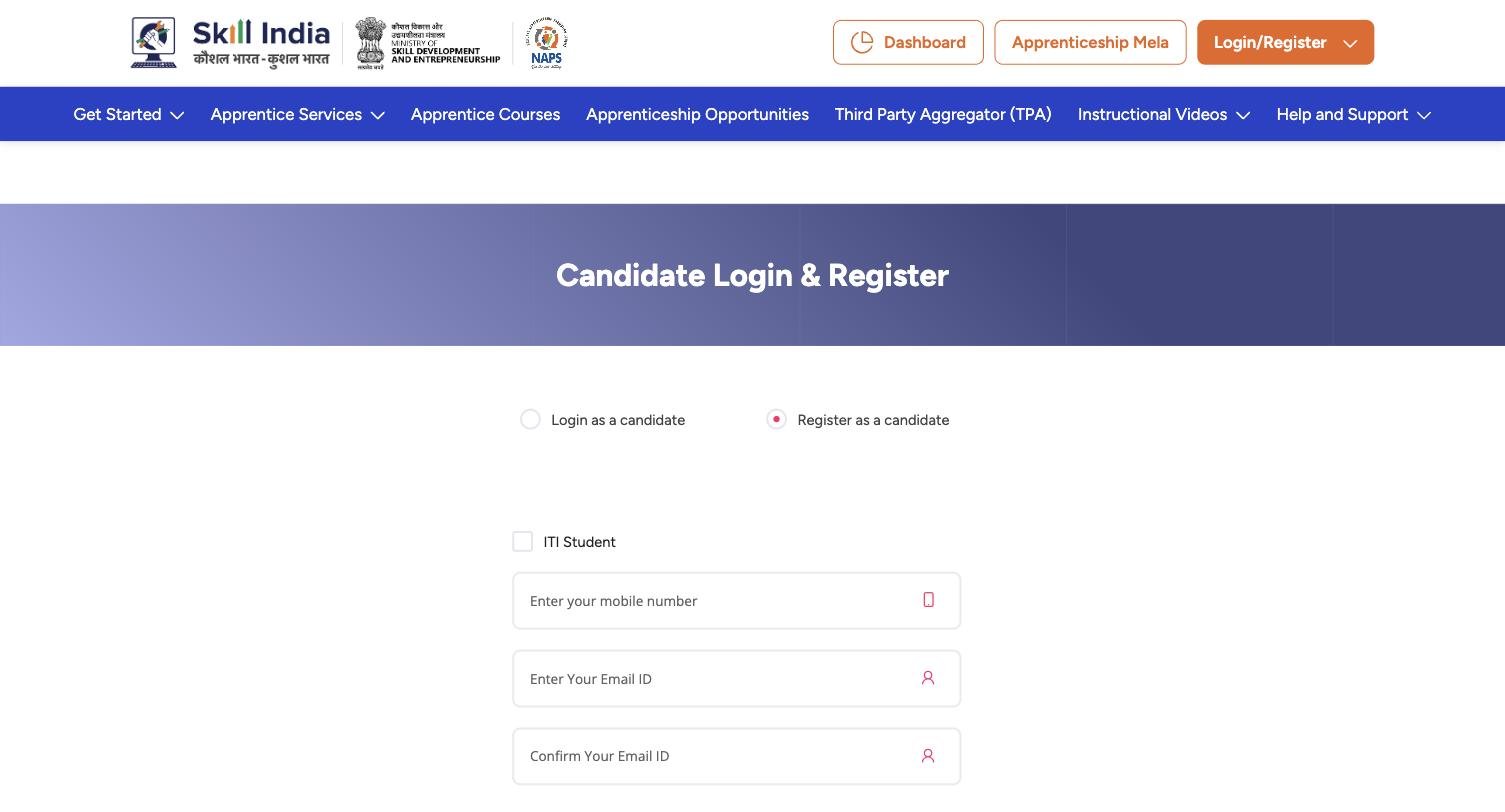
The initial form is short. Select Register as a candidate (the page opens on Login by default in some cases), then enter:
- Mobile number — use one you actively control; portal notifications and OTPs go here.
- Email ID, and Confirm Email ID. These must match.
- CAPTCHA — there is a refresh button and an audio option next to it if the image is unclear.
- Click Register.
Get the email address right the first time. The portal has implemented mandatory email verification and validation measures, and your email is the login identifier — an inactive or mistyped address is the single most common reason candidates end up locked out and raising support tickets.
Step 3 — If you are an ITI student or pass-out, tick the ITI box
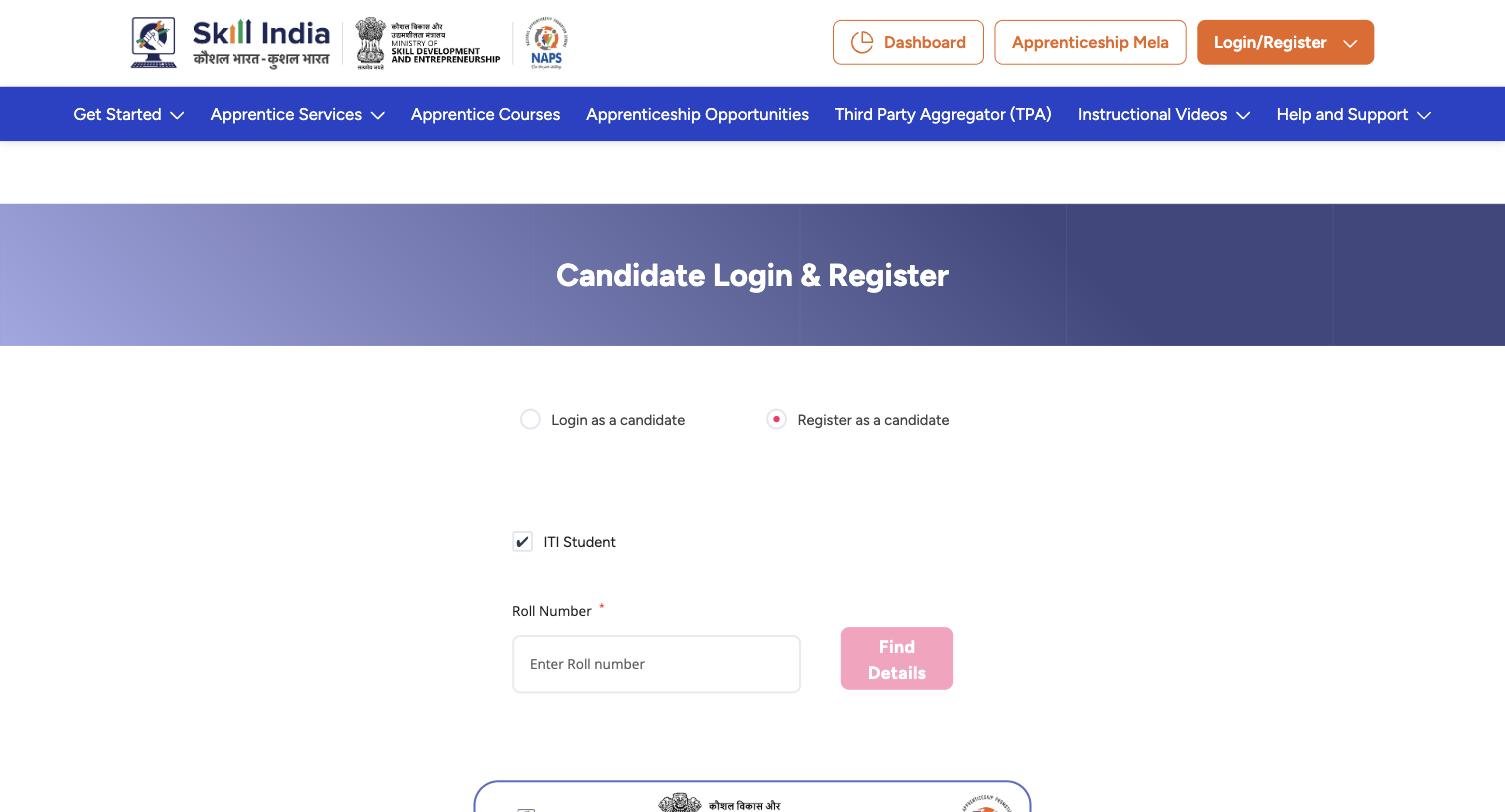
Ticking ITI Student replaces manual data entry with a Roll Number field and a Find Details button. Enter your ITI roll number and the portal fetches your details from existing ITI records.
Use this path if it applies to you. It is faster, and more importantly it avoids the mismatch between what you type and what your certificate says — a mismatch that surfaces later at the contract or certification stage, when it is far more painful to fix. If Find Details returns nothing, check the roll number against your marksheet before assuming the portal is broken.
Step 4 — Activate your account from your email
The portal sends an activation link to the email address you entered. Click it to activate the account, then log in with your email and the password you set. If the link never arrives, check spam first, then use the Resend activation link option on the login page rather than registering a second time — duplicate registrations create problems that are harder to unwind than a missing email.
Step 5 — Complete your profile
Registration creates the account; it does not make you visible to employers. After first login, complete your profile: personal details, educational qualifications and certificates, trade or sector preferences, location preference, and your Aadhaar-based e-KYC and bank account details.
Do not treat e-KYC and bank seeding as optional housekeeping. The portal tracks e-KYC completion as a headline metric — 59.07 lakh completions are shown on the public dashboard — because the government’s stipend share is paid by DBT into an Aadhaar-linked account. Incomplete e-KYC is how apprentices end up working a full month and not receiving the government component.
When uploading your passport-size photo and scanned qualification certificates, make sure they match the portal’s file size limits using our free Photo & Signature Resizer Tool
Step 6 — Search for apprenticeship opportunities
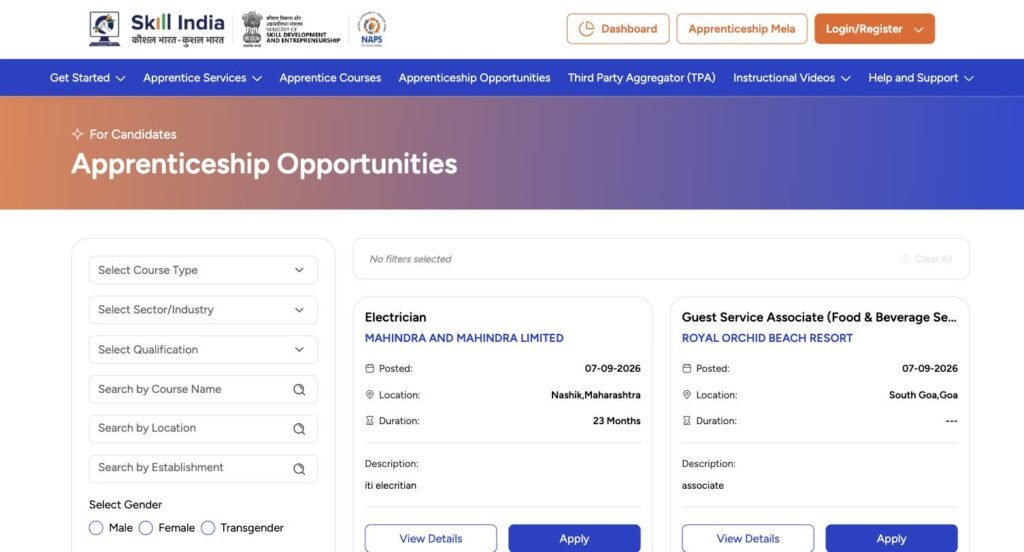
Open Apprenticeship Opportunities from the top navigation. The listing is publicly viewable, and each card shows the trade, the establishment, posting date, location and duration. Filters let you narrow by:
- Course Type (designated or optional trade)
- Sector / Industry
- Qualification
- Course Name, Location, or Establishment name
New vacancies appear continuously through the day, so filtering by location and qualification and checking every few days beats a single exhaustive search. Click View Details to read the full posting — including the stipend for that specific vacancy — before you click Apply.
Step 7 — Apply, get shortlisted, and sign the contract
Applying registers your interest with that establishment. The employer reviews applications, shortlists, and conducts whatever selection it uses — often a short interview or a practical assessment. If selected, the apprenticeship contract is created and signed on the portal itself, not on paper alone. Your training officially begins once that contract is signed and the establishment has completed its side of the process.
Keep applying while you wait. A single application is not a plan, and there is no cap on how many opportunities you can apply to.
What Changed in 2026 — and What Now Trips People Up
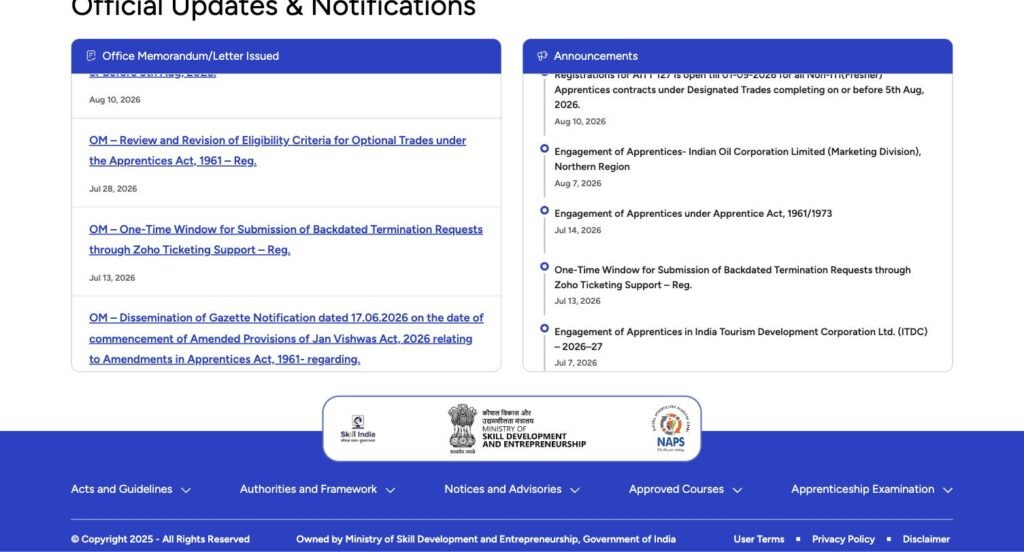
Several changes came into force this year that older guides do not mention at all:
- NAPS–NATS integration and de-duplication. Contract eligibility is now checked in real time across both schemes. You cannot run overlapping apprenticeships.
- A mandatory minimum gap between apprenticeship trainings (Rule 7D). Introduced by the Apprenticeship (Amendment) Rules, 2025, and now enforced on the portal. The rule provides for a minimum one-year gap between two apprenticeship trainings; that a person may undergo a maximum of two apprenticeship trainings, and the second may not be in the same trade; and that no gap is required where the previous training was terminated because of failure on the employer’s part. Where an apprentice terminates for reasons of health, financial hardship, relocation or language barriers, a three-month waiting period applies before a new contract — and no waiting period applies to women.
- An 18% apprenticeship engagement cap has been enabled on the portal by an MSDE Office Memorandum dated 23 April 2026. Under Rule 7B(4) of the Apprenticeship Rules, 1992, the number of apprentices engaged in an establishment in any month must be not less than 2% and not more than 18% of its total strength, subject to fulfilling apprentice-months corresponding to a minimum annual obligation of 2.5%. This governs employers rather than candidates, but it explains why a company you want may show no vacancies — and it means large establishments have more room to engage apprentices than they used to.
- Mandatory email verification is now enforced on the portal.
- Amendments to the Apprentices Act, 1961 under the Jan Vishwas Act, 2026 commenced on 17 June 2026, per a gazette notification circulated on the portal.
- Prior work experience can no longer be demanded for optional trades. An MSDE Office Memorandum dated 28 July 2026 (File No. AP–17/02/2024) directs all Sector Skill Councils to review the eligibility criteria for every optional trade and remove mandatory requirements relating to prior work experience or prior job-specific training. The memorandum states that the Apprentices Act prescribes no such requirement, that Section 18 makes an apprentice a trainee and not a worker, and that apprenticeship is “by design and by law, a training engagement intended for individuals who are yet to acquire practical workplace skills.” Minimum educational qualifications, age requirements and specifically permitted certifications may still be prescribed. If you meet the education and age criteria and a listing still rejects you for lack of experience, that condition is inconsistent with the Act — raise it rather than assuming you are ineligible.
Be Clear About What an Apprenticeship Is Not
This section exists because the scheme is genuinely useful and is also routinely oversold, and you should go in with both halves of the picture.
- You are a trainee, not a worker. Under the Apprentices Act, an apprentice undergoing training is a trainee and not a worker, and labour law provisions do not apply to the apprenticeship. In practical terms, that means no EPF and no ESI during the apprenticeship.
- There is no obligation on the establishment to employ you afterwards. Many do — conversion is the whole appeal of the route, and the portal is full of genuine cases of it — but it is not a legal entitlement, and any recruiter or agent presenting it as guaranteed is misleading you.
- The stipend is a training stipend, not a salary. At the lower slabs it is designed to cover costs while you learn, not to be a living wage.
- Basic training is mandatory for fresher apprentices who have not already completed relevant training. ITI pass-outs, graduates and diploma holders, NSQF-aligned course pass-outs and those currently pursuing a degree or diploma are exempt from it.
Judged honestly, NAPS works best as a structured, certified entry into a specific trade with real workplace exposure and a stipend attached — particularly for ITI and school pass-outs, where the alternatives are usually informal and uncertified. It works least well as a substitute for a job when what you actually need is a job. If you are weighing this against other routes, our comparison of a government job versus a private job in India and our guide to landing a high-paying PSU job both cover where an apprenticeship sits among the entry paths.
To plan your next career transition from apprenticeship to full-time technical roles, explore our step-by-step Career Roadmaps
Common Registration Problems and How to Fix Them
| Problem | What to do |
|---|---|
| Activation email never arrived | Check spam, then use “Resend activation link?” on the login page. Do not register again with a second email. |
| Cannot log in despite correct details | The portal’s own advice is to close and reopen your browser, or reset the password. |
| Wrong mobile number entered | Use the “Update mobile number” option on the login page. |
| ITI “Find Details” returns nothing | Verify the roll number against your ITI marksheet. If it still fails, raise a support ticket via Help and Support rather than registering as a non-ITI candidate. |
| Government stipend share not received | Almost always incomplete Aadhaar e-KYC or a bank account not seeded with Aadhaar. Fix it in your profile, then raise it with your establishment. |
| Not eligible for a new contract | Likely the de-duplication or minimum training-gap check. Verify your apprenticeship history in your account. |
Other Entry Routes Worth Knowing
- PM Internship Scheme — a separate central scheme, open nationwide on a rolling basis, and often a better fit if you want internship experience at a large company rather than trade-specific apprenticeship training.
- National Career Service (NCS) portal registration — the government’s general employment portal, worth registering on alongside the apprenticeship portal.
- Internships & Apprenticeships and Government Jobs — current openings on FreshersJob4U, updated as they are notified.
- Top 10 off-campus hiring companies for freshers in 2026 — if a direct fresher role, rather than a training route, is what you are after.
- IT & Private Jobs for Freshers — active tech, startup, and private sector hiring for diploma holders and fresh graduates.
Frequently Asked Questions (FAQs)
Q1. Is NAPS 2.0 the same as NAPS-2?
Yes. “NAPS 2.0” is how the scheme is commonly searched for; the official documents call it NAPS-2 — the second phase of the National Apprenticeship Promotion Scheme, running since 2022-23.
Q2. Is there any registration fee?
No. Candidate registration on apprenticeshipindia.gov.in is free. Anyone asking you to pay for registration, for a form, or to “confirm” an apprenticeship placement is running a scam.
Q3. I am a B.Tech graduate. Should I register on NAPS or NATS?
Graduate and diploma engineers are generally covered by NATS, on nats.education.gov.in, run by the Ministry of Education through the BOAT/BOPT boards. NAPS mainly covers ITI pass-outs, school pass-outs and candidates in designated and optional trades. Check both, but start with NATS if you hold an engineering degree or diploma.
Q4. How much stipend will I get?
The legal minimum depends on your qualification: ₹6,800 a month for class 5th–9th pass, ₹8,200 for class 10th, ₹9,600 for class 12th and for technician (vocational) apprentices, ₹10,900 for diploma holders and ₹12,300 for graduates — as prescribed under the Apprenticeship (Amendment) Rules, 2025. Establishments may pay more, and the figure for any specific vacancy is shown on that vacancy’s listing. Of that amount, the government contributes 25% of the prescribed minimum, capped at ₹1,500 per month, by DBT into your Aadhaar-linked account — as a component of your stipend, not on top of it.
Q5. Will I get a permanent job after the apprenticeship?
Not automatically. Many establishments do absorb apprentices onto their payroll, and it is one of the strongest arguments for the route, but there is no legal obligation on the employer to employ you after training.
Q6. Do I get PF and ESI as an apprentice?
No. Under the Apprentices Act, an apprentice undergoing training is a trainee and not a worker, and labour law provisions — including EPF and ESI — do not apply during the apprenticeship.
Q7. Can I do a second apprenticeship right after finishing one?
No. Rule 7D requires a minimum one-year gap between two apprenticeship trainings, and caps you at two apprenticeship trainings in total, with the second in a different trade. The exception is where your previous training was terminated because of the employer’s failure, in which case no gap applies. Note also that the government’s 25% stipend share is restricted to first-time training only. The portal enforces this through de-duplication checks across NAPS and NATS, so verify your eligibility in your account before applying.
Q8. NAPS-2 is sanctioned only up to 30 September 2026 — should I still register?
Yes. That date relates to the current sanction of the scheme’s financial support component, which is pending appraisal for continuation under the 16th Finance Commission cycle; apprenticeship itself continues under the Apprentices Act, 1961 regardless. Your registration and profile are not affected. Check the portal’s Office Memorandum section for a fresh extension order before relying on the stipend-support element specifically.
Q9. A listing asks for prior work experience. Am I ineligible as a fresher?
For optional trades, that condition should not be there. An MSDE memorandum of 28 July 2026 directs Sector Skill Councils to remove mandatory prior-work-experience and prior job-specific-training requirements from optional trade eligibility criteria, because the Apprentices Act prescribes no such requirement. Minimum education, age and specifically permitted certifications may still apply.
Q10. What certificate do I get at the end?
For designated trades, you appear for the All India Trade Test and receive a National Apprenticeship Certificate, certified by DGT. For optional trades, certification is issued jointly by the establishment and the relevant Sector Skill Council.
Source & Verification
- Portal verified live: apprenticeshipindia.gov.in — Ministry of Skill Development & Entrepreneurship, Government of India. Screenshots and portal statistics captured 7 September 2026.
- Scheme details, DBT and government share: Press Information Bureau releases on the National Apprenticeship Promotion and Training Schemes.
- Stipend rates, Rule 7D and engagement band: Apprenticeship (Amendment) Rules, 2025 — Gazette Notification G.S.R. 610(E) dated 3 September 2025, published 11 September 2025, as circulated on the apprenticeship portal. Background: PIB release on the Central Apprenticeship Council’s 36% stipend increase, 38th CAC meeting, 26 May 2025.
- Engagement cap and minimum gap enforcement: MSDE Office Memorandum File No. DGT-36/1/2021-AP dated 23 April 2026.
- Optional trade eligibility: MSDE Office Memorandum File No. AP–17/02/2024 dated 28 July 2026.
- Scheme sanction: MSDE Office Memorandum No. AP-15012/5/2020-AP dated 23 April 2026.
- Eligibility, trades, certification and trainee status: Directorate General of Training (DGT) FAQs on apprenticeship under the Apprentices Act, 1961, and MSDE’s NAPS implementation guidelines.
- Scheme sanction period, engagement cap, training-gap and integration notices: Office Memorandums published in the “Official Updates & Notifications” section of the apprenticeship portal.
- Last verified: 7 September 2026
FreshersJob4U is not affiliated with the Ministry of Skill Development & Entrepreneurship, NSDC, or DGT. This guide is for informational purposes only. Government schemes, stipend rates and portal processes change — verify all details, including the current sanction period and the stipend applicable to any specific vacancy, directly on apprenticeshipindia.gov.in before acting on them.

Engineering graduate and founder of FreshersJob4U. I write detailed job guides, interview prep resources, and career roadmaps for freshers and early-career professionals in India. This site started from my own experience with the scattered, confusing fresher job search — I wanted to build something cleaner.