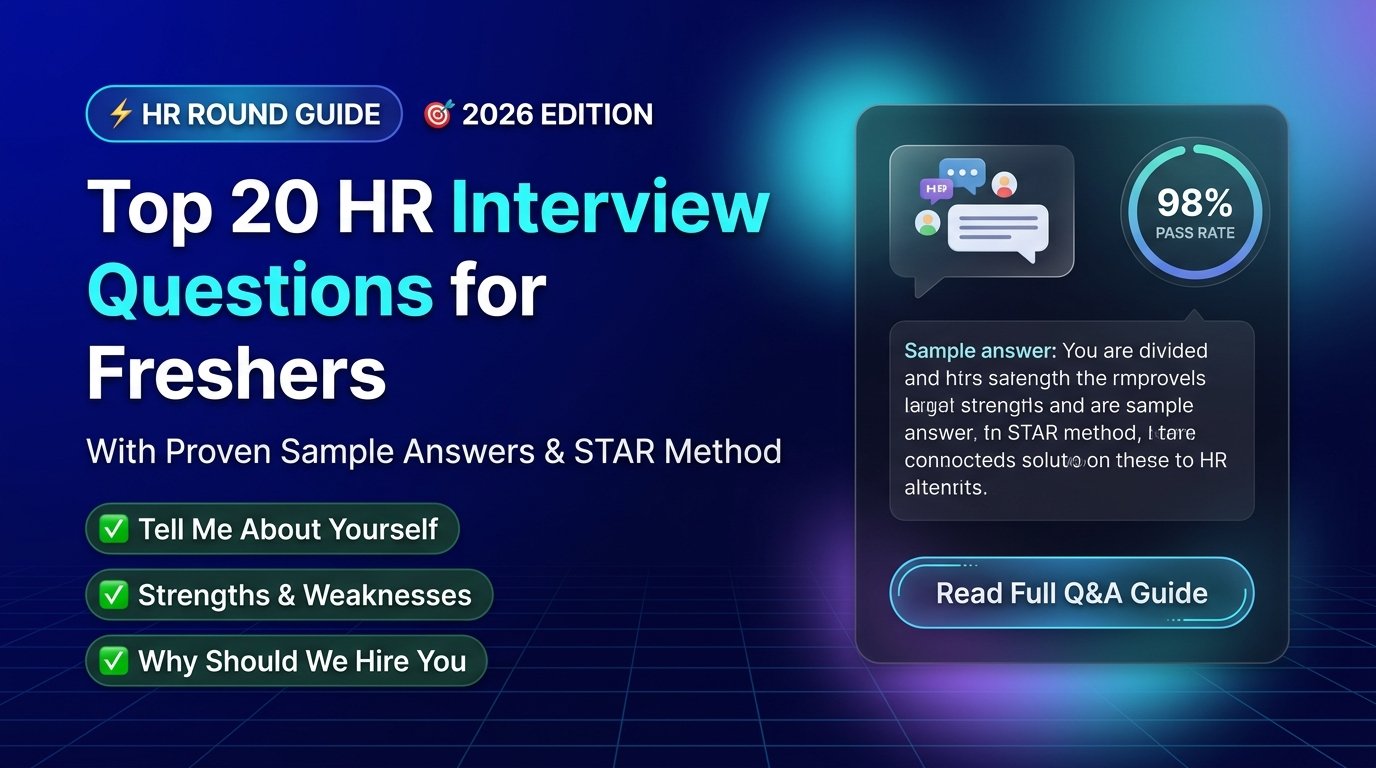
The HR round is often the last stage of a fresher interview, but it’s also the one most candidates prepare for the least. Technical rounds test what you know; the HR round tests how you communicate, how self-aware you are, and whether you’ll fit into the team. Most HR interviewers aren’t looking for a perfect, rehearsed script — they’re checking whether your answers sound honest, specific, and thought through.
This guide covers 20 questions that come up repeatedly in HR interviews for freshers in India, why interviewers ask each one, a sample answer to show you the structure, and a short tip on what to avoid. Use the sample answers as a template, not a script to memorize word-for-word — HR panels notice when an answer sounds copied rather than personal.
How to Use This Guide
Before going through the questions, keep three things in mind:
- Personalize every answer. Replace the sample details with your own projects, internships, and experiences. An HR interviewer has heard the generic version of every answer here — specificity is what makes yours memorable.
- Keep answers under two minutes. Freshers often over-explain. Aim for a tight, structured answer, and let the interviewer ask a follow-up if they want more detail.
- Research the company beforehand. Several questions below assume you’ve looked at the company’s website, recent news, and the specific role you’re applying for.
1. Tell Me About Yourself
Why it’s asked: This is usually the opening question, and it sets the tone for the rest of the interview. The interviewer wants a quick, structured summary — not your full life story.
Sample Answer: “I recently completed my B.Tech in Computer Science from XYZ College with a CGPA of 8.2. During my final year, I worked on a project that used machine learning to predict crop yields, which is where I first got interested in data science. I also did a two-month internship at a startup, where I worked on cleaning and analyzing customer data. Outside of academics, I’ve been part of my college’s coding club, where I helped organize a hackathon. I’m now looking for a role where I can apply what I’ve learned and keep growing as a data analyst.”
Tip: Structure this as: education → most relevant project or internship → one extracurricular detail → what you’re looking for now. Keep it to 90 seconds.
2. What Are Your Strengths?
Why it’s asked: Interviewers want to see if you can identify your own strengths clearly, and whether those strengths are relevant to the role.
Sample Answer: “One of my key strengths is problem-solving under time pressure. During a college hackathon, our team’s app crashed two hours before the final demo, and I was able to trace the bug and fix it while keeping the rest of the team calm. I also tend to be detail-oriented — in my internship, I caught a data mismatch that would have affected a client report, simply because I double-checked the numbers before submission.”
Tip: Pick two strengths, not five, and back each one with a specific example. A strength without an example sounds like a claim, not a fact.
3. What Are Your Weaknesses?
Why it’s asked: This checks self-awareness and honesty. Interviewers are wary of rehearsed “strengths disguised as weaknesses” like “I work too hard.”
Sample Answer: “I used to struggle with public speaking — I’d get nervous presenting in front of a large group. I worked on this by volunteering to present my project findings during college seminars, and I also joined a public speaking club for a semester. I’m still not the most naturally confident speaker, but I’ve become noticeably more comfortable, and I keep pushing myself to take on presentation opportunities.”
Tip: Choose a real, moderate weakness — not a job-critical skill — and show a concrete step you’ve taken to improve it. Avoid clichés like “I’m a perfectionist.”
4. Why Should We Hire You?
Why it’s asked: This is your chance to directly connect your skills to what the company needs. It also shows how well you understand the role.
Sample Answer: “From the job description, I understand you’re looking for someone who can work with SQL and build dashboards for the reporting team. In my internship, I built three dashboards in Power BI that the operations team still uses for weekly reporting, and I’m comfortable writing SQL queries to pull and clean data. Beyond the technical fit, I’m someone who asks questions early rather than making assumptions, which I think reduces rework on a team.”
Tip: Reference the actual job description if you can. A generic answer here is an immediate missed opportunity.
5. Where Do You See Yourself in 5 Years?
Why it’s asked: Interviewers want to know if you’re thinking about your career with any direction, and whether that direction is realistic for a fresher.
Sample Answer: “In the next few years, I want to build strong hands-on experience in data analysis and eventually move into a role where I can lead small projects or mentor newer team members. I’m not fixed on a specific job title — I’m more focused on continuously building skills and taking on more responsibility as I prove myself.”
Tip: Avoid naming a specific senior title (like “Manager” or “Team Lead”) too confidently — it can sound presumptuous for a fresher role. Focus on growth and contribution instead.
6. Why Do You Want to Join Our Company?
Why it’s asked: This tests whether you’ve actually researched the company, or you’re applying to anyone who’ll hire you.
Sample Answer: “I’ve been following your company’s work in the fintech space, particularly the recent expansion into digital lending. I like that the company works on products that directly reach a large number of first-time users, and I’d like to be part of a team that’s solving real financial access problems rather than working on a purely internal tool.”
Tip: Mention one specific, verifiable fact about the company — a product, a recent announcement, or their mission. Generic answers like “I’ve heard good things about the culture” are easy to spot.
7. What Do You Know About Our Company?
Why it’s asked: Similar to the previous question, but more direct — this checks basic preparation.
Sample Answer: “You’re a fintech company that started around 2015, and you primarily work in digital lending and payments. I read that you recently crossed a significant user milestone and expanded into a new city. I also noticed from the job description that this role sits within your data team, supporting credit risk analysis.”
Tip: Check the company’s About page, recent press releases, and the specific team the role belongs to. Five minutes of research here goes a long way.
8. Are You Willing to Relocate or Work in Shifts?
Why it’s asked: This is a practical logistics question, especially common for roles with rotational shifts or a fixed office location.
Sample Answer: “Yes, I’m open to relocating to [city] for this role. I’ve already looked into accommodation options nearby, so I can be ready to join within the notice period mentioned.”
Tip: Answer honestly. If you have a genuine constraint, say so clearly and briefly rather than agreeing and backing out later — that costs you more credibility than a direct “no” upfront.
9. What Is Your Expected Salary?
Why it’s asked: HR wants to check whether your expectations are within the company’s budget for the role before proceeding further.
Sample Answer: “I don’t have a fixed number in mind — I’d like to understand the complete compensation structure for this role first. Based on my research into industry standards for a fresher role in this field, I’d expect something in the range of [X to Y], but I’m open to discussing this further based on the responsibilities and growth opportunities.”
Tip: Research the typical fresher salary range for the specific role and city beforehand — vague answers like “whatever is standard” can come across as unprepared, not flexible.
10. Tell Me About a Time You Worked in a Team
Why it’s asked: Almost every job involves collaboration. This checks how you behave in group settings, not just whether you can code or analyze data alone.
Sample Answer: “During my final-year project, our team of four had to build a web application within six weeks. I took on the role of coordinating tasks and tracking progress, since two teammates were more focused on backend work and one on the frontend. When we fell behind schedule two weeks in, I suggested we split into smaller daily check-ins instead of one weekly meeting, which helped us catch issues earlier and finish on time.”
Tip: Use the STAR format — Situation, Task, Action, Result — even if you don’t say it out loud. It keeps your answer structured instead of rambling.
11. How Do You Handle Pressure or Tight Deadlines?
Why it’s asked: Every role has busy periods. Interviewers want a real example, not just a claim that you “work well under pressure.”
Sample Answer: “During my internship, I had to complete a data cleaning task for a client report with only one day’s notice due to a schedule change. I broke the task into smaller chunks, prioritized the fields that mattered most for the report, and communicated early with my manager about what I could realistically finish. I submitted it on time, and my manager appreciated that I flagged the timeline honestly rather than promising more than I could deliver.”
Tip: Show a specific method you use — prioritizing, breaking tasks down, communicating early — rather than just saying you “stay calm.”
12. What Motivates You?
Why it’s asked: This helps HR understand what kind of work environment and tasks will keep you engaged long-term.
Sample Answer: “I’m motivated by solving problems that have a visible impact. In my internship, seeing the dashboard I built actually being used by the operations team every week — and hearing that it saved them time — was more satisfying than just completing the task itself. I like knowing that my work is actually useful to someone.”
Tip: Avoid generic answers like “money” or “learning new things” without elaboration — tie your motivation to a specific experience.
13. Why Did You Choose This Field or Branch?
Why it’s asked: This is common for engineering and specialized-degree graduates, checking whether your career choice was deliberate or accidental.
Sample Answer: “I chose computer science because I was drawn to how logical problem-solving translates into something people actually use — an app, a website, a tool. In school, I enjoyed mathematics and started learning basic programming on my own before college, which confirmed that this was the right direction for me.”
Tip: It’s fine if your reason evolved over time — just be honest and specific rather than giving a rehearsed, overly polished answer.
14. What Are Your Short-Term and Long-Term Goals?
Why it’s asked: This checks whether your immediate goals (the job you’re interviewing for) align with your bigger-picture direction.
Sample Answer: “In the short term, my goal is to build strong practical experience in this role and understand how the business actually works, not just the technical side. In the long term, I’d like to specialize further in data analytics and eventually take on more ownership of projects, whether that’s through more advanced technical work or a leadership path.”
Tip: Make sure your short-term goal clearly matches the role you’re applying for — a mismatch here raises doubts about your commitment.
15. How Do You Handle Failure or Rejection?
Why it’s asked: Every career involves setbacks. This checks resilience and whether you can learn from mistakes rather than getting discouraged.
Sample Answer: “In my second year, I applied for a summer internship and got rejected after the technical round. Instead of getting discouraged, I asked a senior for feedback on what went wrong, realized my data structures fundamentals were weak, and spent the next two months working through practice problems. I cleared a similar interview the following semester.”
Tip: Show what you specifically changed after the failure — the “what I did differently” part is what makes this answer convincing.
16. What Is Your Greatest Achievement?
Why it’s asked: This gives the interviewer insight into what you personally consider meaningful, and how you talk about your own work.
Sample Answer: “My biggest achievement so far was leading my college’s technical fest as part of the core organizing team. We managed a budget, coordinated with over 15 volunteers, and hosted events for more than 500 participants. It taught me a lot about planning, delegation, and handling last-minute problems calmly, which I don’t think I would have learned purely from academics.”
Tip: The achievement doesn’t have to be strictly academic or technical — leadership, initiative, or persistence in a non-academic setting works just as well, as long as you explain what you learned.
17. How Would Your Friends or Professors Describe You?
Why it’s asked: This is an indirect way of asking about your strengths, but from an outside perspective, which can feel more genuine than self-praise.
Sample Answer: “I think my professors would describe me as consistent and dependable — I rarely missed a deadline throughout my degree, even during heavy exam periods. My friends would probably say I’m the one who double-checks things before submission, sometimes to a fault, since I like to be thorough.”
Tip: If possible, mention this is something you’ve actually heard, not just what you assume they’d say — it adds credibility.
18. Are You Comfortable Working Individually or in a Team?
Why it’s asked: Some roles require heavy collaboration; others involve long stretches of independent, focused work. This checks flexibility.
Sample Answer: “I’m comfortable with both. I enjoy focused, independent work when I need to dig deep into a problem, like debugging or analysis. At the same time, I’ve worked on several group projects and genuinely enjoy the back-and-forth of solving a problem together — I think the two complement each other well.”
Tip: Avoid picking only one extreme. Most roles need a mix of both, so show you can adapt to either mode.
19. Do You Have Any Questions for Us?
Why it’s asked: This is almost always the closing question. Saying “no” can make you look uninterested or unprepared.
Sample Answer: “Yes — could you tell me more about what a typical first three months in this role look like? Also, is there a structured training or mentorship process for freshers joining this team?”
Tip: Prepare two or three genuine questions in advance, ideally about the team, growth path, or what success looks like in the role — avoid asking anything you could have found on the company’s website.
20. Why Should We Not Hire You? / What Makes You Different From Other Candidates?
Why it’s asked: This is a tougher variant of “why should we hire you,” designed to see how you handle a slightly uncomfortable question without getting defensive.
Sample Answer: “Honestly, I don’t have professional work experience beyond my internship, so there will be a learning curve on certain enterprise tools your team uses. What I can offer instead is a genuine willingness to learn quickly, and I’ve shown that ability consistently — picking up new tools during my internship within days of being introduced to them. I’d rather be upfront about this than overstate my experience.”
Tip: Don’t dodge the question or claim you have no weaknesses relative to other candidates. Acknowledge a real gap, then pivot to how you compensate for it.
Common Mistakes Freshers Make in HR Interviews
- Memorizing answers word-for-word. It’s obvious to interviewers and falls apart the moment a follow-up question comes.
- Giving vague answers with no examples. Claims like “I’m a hard worker” mean little without a specific instance backing them up.
- Not researching the company or role. Several questions above directly test this — skipping it is one of the most avoidable mistakes.
- Speaking negatively about a college, professor, or previous internship. Even if something genuinely went wrong, frame it neutrally and focus on what you learned.
- Not preparing questions to ask back. It’s a missed opportunity to show genuine interest in the role.
Frequently Asked Questions (FAQs)
Q1. How long should HR interview answers be for freshers?
Most answers should be 60–90 seconds. Longer answers risk losing the interviewer’s attention or drifting off-topic.
Q2. Is it okay to say I don’t have an answer to a question?
Yes, occasionally — it’s better to say “I haven’t thought about that specifically, but here’s how I’d approach it” than to give a fabricated, unconvincing answer.
Q3. Should freshers negotiate salary in the HR round?
Light negotiation is acceptable if you have a researched range in mind, but avoid being rigid — for a first job, growth opportunities and learning often matter as much as the starting number.
Q4. What should I wear for an HR interview?
Formal or business-casual attire is generally safest for in-person interviews, unless the company has specifically indicated a casual dress code.
Q5. How do I calm my nerves before an HR interview?
Practicing answers out loud (not just reading them), preparing a few company-specific questions in advance, and reminding yourself that the interviewer wants to understand you, not catch you out, can help reduce pre-interview anxiety.

Engineering graduate and founder of FreshersJob4U. I write detailed job guides, interview prep resources, and career roadmaps for freshers and early-career professionals in India. This site started from my own experience with the scattered, confusing fresher job search — I wanted to build something cleaner.