If you’ve spent any time scrolling job portals lately, you’ve probably noticed the same thing: half the openings in the “data” space have titles that sound almost interchangeable. Data Analyst. Data Scientist. Machine Learning Engineer. The job descriptions mention SQL, Python, and “insights” in all three, and if you’re a fresher trying to figure out where to point your next six months of learning, that overlap can feel less like flexibility and more like confusion.
Here’s the good news: these three roles are genuinely different jobs, with different day-to-day work, different skill emphases, and different kinds of people who tend to enjoy them. The confusion mostly comes from the fact that all three sit on the same spectrum — working with data to help a business make better decisions — but they sit at very different points on that spectrum.
This guide walks through what each role actually involves, using real workplace scenarios rather than dictionary definitions, so you can figure out which one genuinely fits how you think and what you enjoy doing, rather than picking based on which title sounds more impressive on LinkedIn.
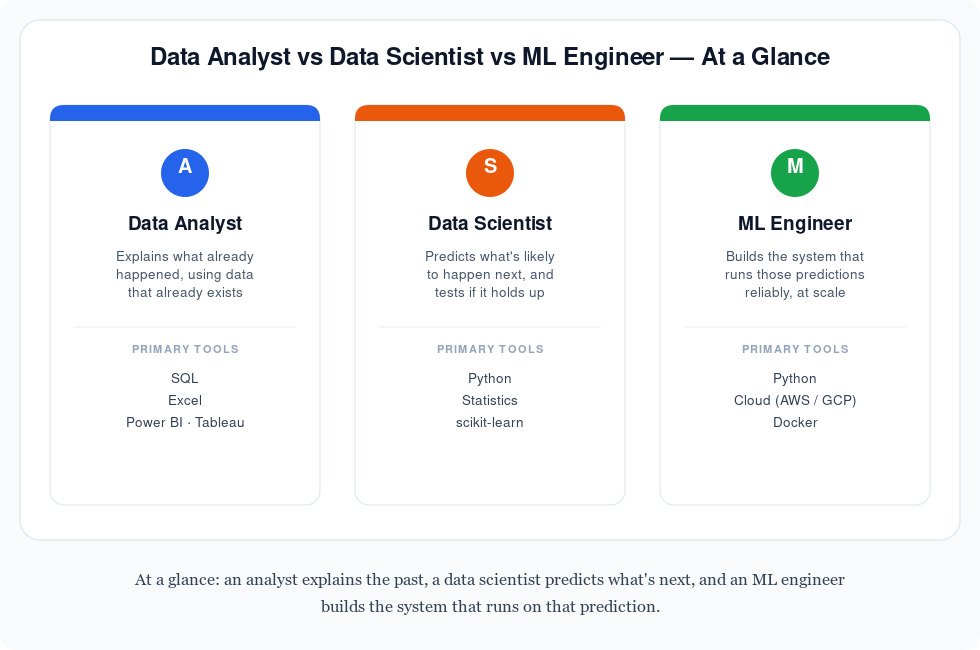
Table of Contents
One Company, Three Very Different Jobs
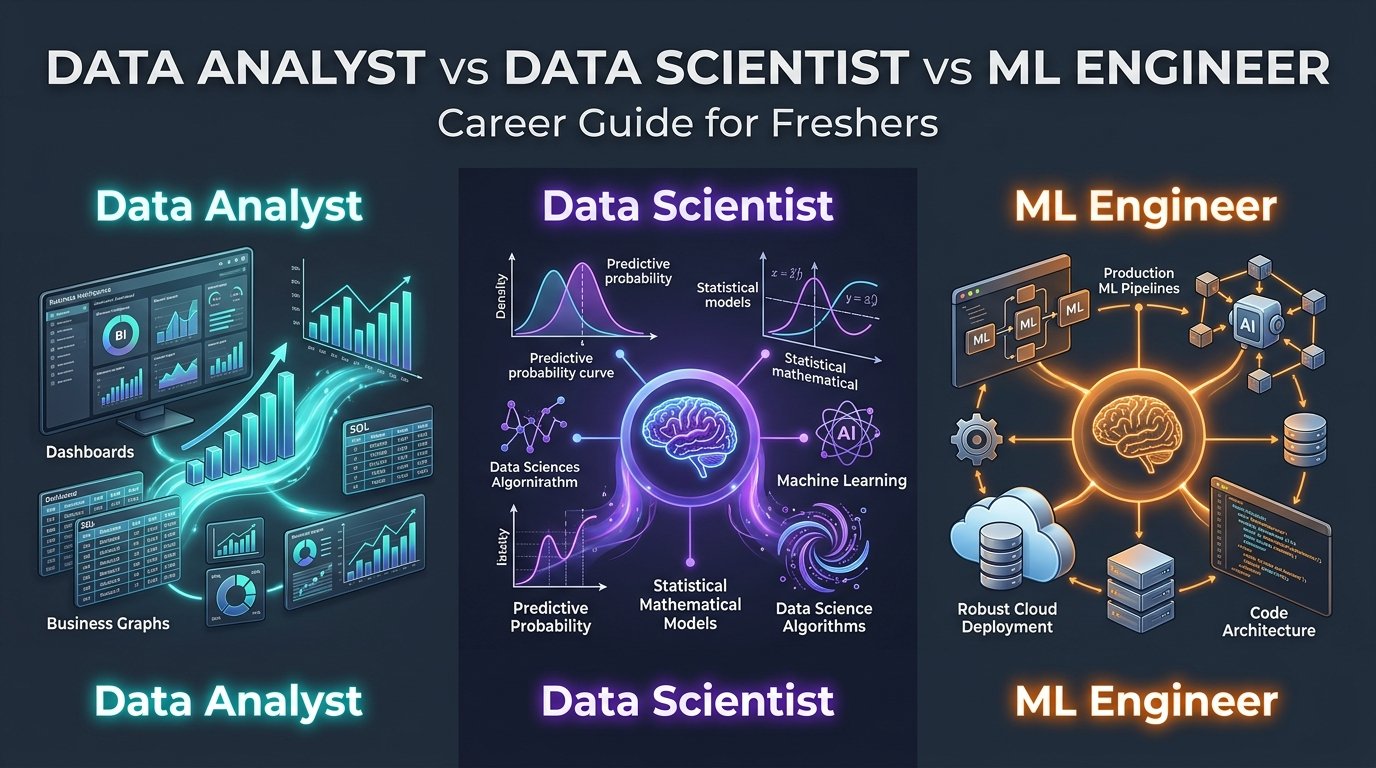
Imagine an online grocery delivery app. Over the last quarter, more customers than usual have been abandoning their carts before checkout. Here’s how each of our three roles would approach that exact same problem.
The Data Analyst pulls the order data, breaks it down by city, time of day, and payment method, and finds that cart abandonment spikes specifically between 9 and 10 PM, mostly on a particular payment gateway that’s been timing out. They build a dashboard the operations team can check weekly, and recommend switching the default payment provider during peak hours. Their job was to explain what happened and why, using data that already exists.
The Data Scientist gets asked a forward-looking version of the same problem: “Can we predict which customers are likely to abandon their cart before they actually do, so we can offer them a small discount in real time?” They build a statistical model using past behaviour — browsing time, cart value, past order history — to estimate the probability of abandonment for each active session. Their job was to predict what’s likely to happen next, and to test whether that prediction actually holds up on new data.
The ML Engineer takes that same prediction model and makes it actually work inside the live app — serving predictions in real time as thousands of customers browse simultaneously, without slowing the app down, and automatically retraining the model every week as new data comes in. Their job was to turn a working idea into a reliable, running piece of software that the company can depend on every single day, not just in a research notebook.
Same company, same underlying problem, three completely different skill sets in play. That’s the clearest way to hold these roles in your head as you read the rest of this guide.
Data Analyst Career for Freshers: What the Role Involves
A Data Analyst’s core job is to make sense of data that already exists and turn it into something a non-technical manager can act on. Most of the actual work is less glamorous than the job title suggests — a lot of it is cleaning messy spreadsheets, writing queries to pull the right numbers out of a database, and building charts and dashboards that answer specific business questions like “which product category is underperforming this month” or “are customers from Tier 2 cities converting at a lower rate, and if so, why.”
The tools of the trade are fairly consistent across most analyst job descriptions:
- SQL — the language used to ask questions of a database, and the single most non-negotiable skill in this role.
- Excel or Google Sheets — still where a surprising amount of real analyst work actually happens.
- Power BI or Tableau — a visualization tool that turns raw numbers into charts a business team can actually read at a glance.
- Basic Python or R (sometimes) — expected in some analyst roles, mostly for automating repetitive reporting tasks rather than for anything mathematically advanced.
What tends to separate a good analyst from an average one isn’t technical depth — it’s curiosity and communication. A strong analyst doesn’t just report that sales dropped 12%; they dig into why, and they explain it in a way a marketing head with zero technical background can immediately understand and act on. If you enjoy puzzles, storytelling with numbers, and the satisfaction of a clean, clear chart that makes a messy problem obvious, this role tends to feel natural rather than exhausting.
If you want to see what this looks like in an actual job posting, check Collins Aerospace Associate Engineer – Data Analytics Recruitment 2026
Data Scientist Career for Freshers: What the Role Involves
A Data Scientist’s job starts roughly where an analyst’s ends. Instead of only explaining what already happened, a data scientist builds models that estimate what’s likely to happen next, or that uncover patterns too complex for a simple chart to reveal — things like which customers are likely to churn next month, what price point maximises revenue without hurting conversion, or which loan applications carry a higher default risk.
This role leans more heavily on statistics and mathematics than the analyst role does. The concepts you’ll actually work with day to day include:
- Regression — estimating how one factor influences another, such as how price affects sales.
- Hypothesis testing — checking whether a pattern in your data is real or just random noise.
- Machine learning techniques — increasingly central to the role, used to build the predictive models themselves.
- Python and its ecosystem — close to universal here, usually alongside libraries like pandas and scikit-learn, and sometimes deep learning frameworks depending on the company and the problem.
A useful way to think about the difference from an analyst: an analyst is usually confident their explanation is correct, because they’re describing something that already happened. A data scientist is constantly working with uncertainty — a model that predicts churn with 80% accuracy is genuinely useful, but it’s also wrong one time in five, and part of the job is understanding and communicating that uncertainty honestly rather than presenting a prediction as a guarantee.
If you enjoy the scientific side of problem-solving — forming a hypothesis, testing it rigorously, and being comfortable when the answer is “probably, with 80% confidence” rather than a clean yes or no — this role tends to be a stronger fit than the more report-driven analyst work.
Nielsen AI/ML Data Scientist I Recruitment 2026 is a live example of what this looks like at the fresher/early-career level.
ML Engineer Career for Freshers: What the Role Involves
A Machine Learning Engineer’s job is to take a model — often one a data scientist has already built and validated — and turn it into a reliable, running piece of production software. This is where data science meets software engineering, and it’s genuinely a different discipline from the other two, even though the job listings often blur the line.
Concretely, this means writing well-structured, tested code rather than the exploratory notebook-style scripts a data scientist might use for research, and deploying models so they can respond to real requests — often through an API, which is essentially a defined way for one piece of software to ask another piece of software for an answer.
It also means building the pipelines that retrain and monitor models over time, so they don’t quietly become inaccurate as real-world data shifts. This ongoing discipline of keeping ML systems running reliably in production is often called MLOps, a term you’ll see a lot in ML engineering job postings.
Because of this, an ML Engineer typically needs a stronger software engineering foundation than the other two roles:
- Solid programming fundamentals — the part freshers coming from a purely analytics background most often underestimate.
- An understanding of how systems scale — what happens to your model when a thousand people hit it at once.
- Cloud platforms — familiarity with AWS, Azure, or GCP, since that’s where these systems actually run.
- Containerization tools like Docker — increasingly a standard expectation rather than a bonus skill.
The machine learning knowledge itself often overlaps with what a data scientist knows, but the emphasis shifts heavily from “is this model statistically sound” to “will this model keep working reliably when a thousand people hit it at once, and can I catch it quietly breaking before anyone notices.”
If you’re the kind of person who enjoys building things that actually run and hold up under pressure, rather than research and analysis for its own sake, this role tends to be the better fit of the three.
Tower Research Capital AI/ML Intern Recruitment 2027 is a live example of what this looks like at the fresher/early-career level.
Data Analyst vs Data Scientist vs ML Engineer: Side-by-Side Comparison
| Aspect | Data Analyst | Data Scientist | ML Engineer |
|---|---|---|---|
| Core question they answer | What happened, and why? | What’s likely to happen next? | How do we make that prediction run reliably, at scale? |
| Primary tools | SQL, Excel, Power BI/Tableau | Python, statistics, scikit-learn | Python, cloud platforms, Docker, deployment tools |
| Math/stats intensity | Basic to moderate | High | Moderate to high (plus strong coding) |
| Coding intensity | Light to moderate | Moderate to high | High — closer to software engineering |
| Typical output | Dashboards, reports, recommendations | Predictive models, experiments, insights | Deployed, running ML systems and pipelines |
| Best suited to someone who enjoys | Storytelling with data, business context, clear communication | Statistical reasoning, hypothesis-driven problem solving | Building and maintaining real software systems |
Shared Skills vs Skills That Set Them Apart
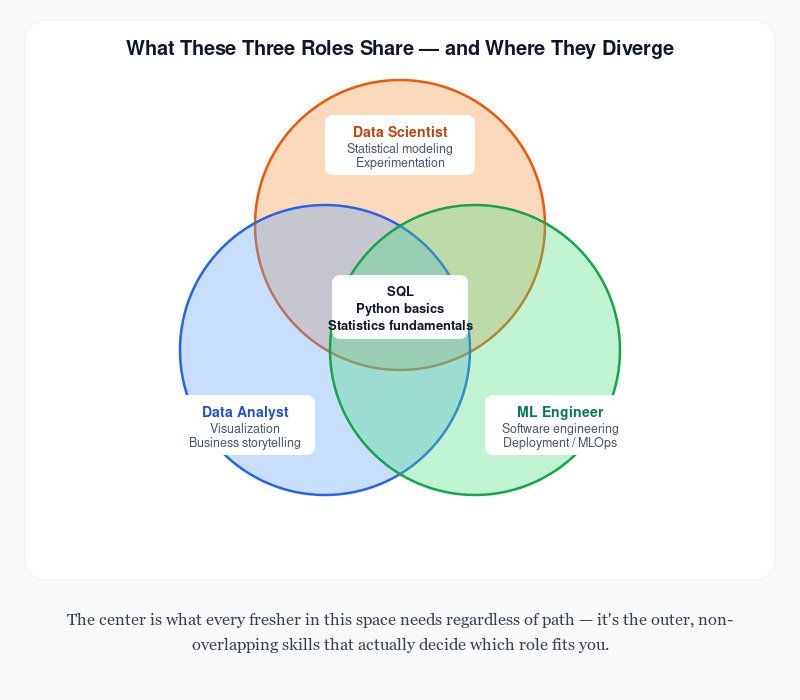
It’s worth being honest about how much these three roles actually share, because that overlap is exactly why the job titles feel so blurry from the outside. All three typically expect a working knowledge of SQL, basic statistics, and at least beginner-level Python. All three involve working with real, messy data and communicating findings to people who aren’t going to read your code.
Where they genuinely diverge is in what sits on top of that shared foundation. An analyst builds outward into visualization and business communication. A data scientist builds outward into deeper statistics, experimentation, and machine learning theory. An ML engineer builds outward into software engineering — system design, scalable code, and deployment infrastructure.
None of these extensions is “harder” than the others in some absolute sense; they’re just different directions, which is exactly why a strong analyst and a strong ML engineer can look, on paper, like they barely have anything in common, despite starting from a very similar base.
Learning Curve: Which One Is Realistically Faster to Break Into?
This is one of the more practical questions freshers actually care about, and the honest answer is that the three paths are not equally quick to learn — though “quick” here is relative, and none of them is something you’ll genuinely master in a few weeks regardless of what an ad for a bootcamp might imply.
Of the three, the Data Analyst path is generally the fastest to become job-ready in, because the core toolkit — SQL, Excel, and one visualization tool — is narrower and more immediately practical. Many freshers with focused, consistent effort can build a credible portfolio and start applying within a few months, even coming from a non-technical background.
The Data Scientist path usually takes longer, mainly because statistics and machine learning have a real conceptual depth to them that doesn’t compress well — you can learn to call a Python function that trains a model in an afternoon, but understanding when that model’s results can actually be trusted takes considerably longer to build real intuition for.
The ML Engineer path is often the least predictable in terms of timeline, because it depends heavily on your starting point. If you already come from a computer science or software engineering background, layering machine learning knowledge on top can be quite fast. If you’re starting with no programming foundation at all, this is typically the longest of the three paths, since you’re effectively building two skill sets — software engineering and machine learning — rather than one.
None of this means you should default to the analyst path purely because it’s faster. A role you find genuinely engaging is one you’ll actually stick with long enough to get good at — and that matters more for your eventual outcome than shaving a couple of months off the starting line.
Salary Expectations for Freshers in India
Salary numbers in this space move around a fair bit depending on the source, the city, the type of company, and how strictly “fresher” is defined — some listings labeled “fresher Data Scientist,” for instance, are really looking for candidates with a strong internship or project portfolio rather than someone with genuinely zero prior exposure. With that caveat, here’s a realistic, cross-checked range rather than a single confident number:
| Role | Typical Fresher Range (India, per annum) | Notes |
|---|---|---|
| Data Analyst | Roughly ₹3–8 LPA | Higher end typically at product-based tech companies in cities like Bengaluru; service-company offers tend to sit lower in this range |
| Data Scientist | Roughly ₹5–12 LPA | Genuine “Data Scientist” titles for zero-experience freshers are less common than the title suggests — many freshers enter as Junior/Associate Data Scientist or start as an analyst first |
| ML Engineer | Roughly ₹5–10 LPA on average, higher at AI-focused product companies | Entry-level averages tend to sit lower than the hype suggests industry-wide, but strong candidates at AI-first startups and large tech firms can see meaningfully higher offers |
Treat these as a general sense of the landscape, not a promise — actual offers vary widely based on your specific skills, the strength of your project portfolio, and the company you’re interviewing with. A fresher with a genuinely strong SQL and Python portfolio can out-earn another candidate with a fancier job title but a thinner skill set, and that’s true across all three roles.
Job Market Demand: Where the Openings Actually Are
India’s data and analytics hiring market has continued to grow steadily, and demand hasn’t slowed down — but it’s worth understanding where most of that demand actually sits, because it’s not evenly split across the three roles. The largest volume of entry-level openings, by a clear margin, is still in data analyst and analyst-adjacent roles, simply because almost every mid-sized and large company needs people who can turn raw data into readable reports, regardless of whether that company is doing any advanced machine learning work at all.
Browse current AI/ML Jobs on FreshersJob4U to get a live sense of this split yourself.
Pure “Data Scientist” and “ML Engineer” openings for absolute freshers exist, but they’re comparatively fewer and more competitive, and many companies genuinely prefer candidates with at least one solid internship, a strong project portfolio, or a relevant postgraduate specialization before handing over that title.
This isn’t meant to discourage you from aiming for those roles — plenty of freshers do land them directly — but it’s a realistic reason many career paths in this space start with an analyst role and grow into data science or ML engineering over the first two to three years, rather than starting there directly.
One more honest trend worth knowing: generative AI tools are increasingly automating some of the routine parts of analyst work, like writing basic SQL queries or first-draft chart summaries. This hasn’t reduced demand for analysts so much as shifted what’s valued — the ability to ask the right business question and judge whether an answer actually makes sense is becoming more important than raw query-writing speed. That’s a useful thing to keep in mind regardless of which of the three paths you choose, since all of them increasingly reward judgment over mechanical execution.
Which Role Might Actually Suit You?
Rather than a checklist, it’s more useful to think about this as a few honest questions to ask yourself.
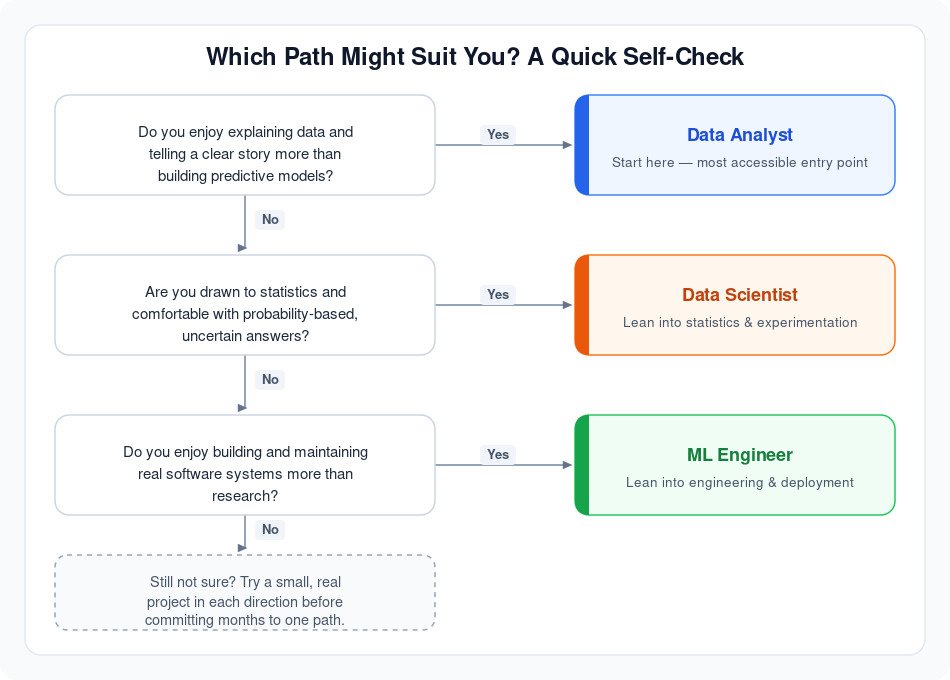
If you enjoy digging into “why” something happened, like explaining things clearly to people who aren’t technical, and get satisfaction from a clean, well-organised report or dashboard more than from the maths itself, the Data Analyst path is likely to feel like a natural fit — and it also happens to be the most accessible entry point of the three.
If you’re drawn to statistics and enjoy the process of forming a hypothesis and testing whether it holds up, and you’re comfortable with the idea that your model will sometimes be wrong and that’s part of the job rather than a failure, the Data Scientist path tends to suit that kind of mind well.
If what actually excites you is building things — software that runs, holds up under real usage, and doesn’t fall over when a thousand people use it at once — and you don’t mind that the “machine learning” part of your day might be smaller than the “solid engineering” part, the ML Engineer path is usually the better fit, even if the title sounds the most glamorous of the three.
And if none of these feels obviously right yet, that’s a completely normal place to be as a fresher — the honest move is to try a small, real project in each direction (a dashboard, a simple prediction model, a small deployed script) before committing months of study to one path based on a job title alone.
A Realistic Fresher Roadmap for Each Path
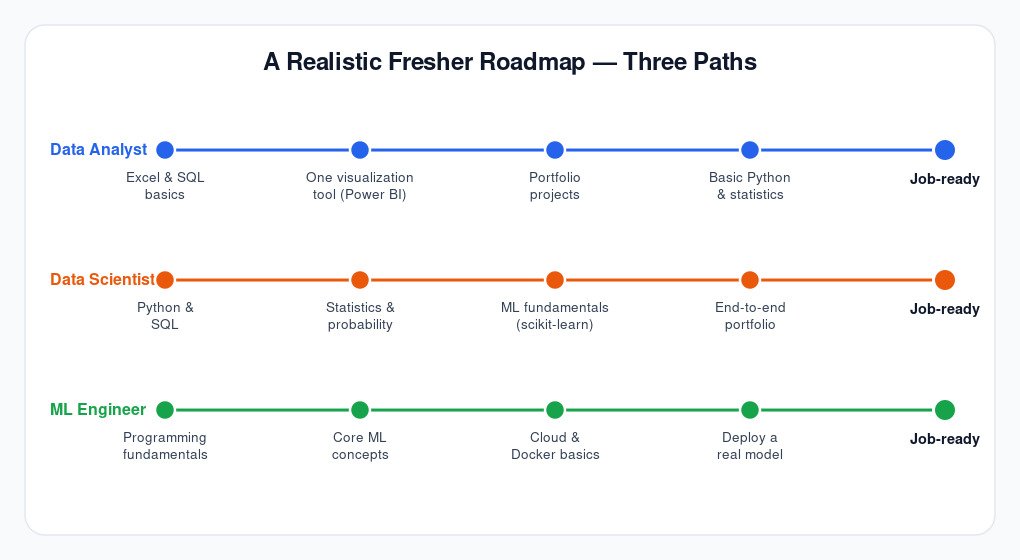
These are intentionally broad-strokes roadmaps rather than week-by-week syllabi, since the right pace and resources depend a lot on your starting point and how much time you can dedicate.
For an aspiring Data Analyst, the realistic sequence is usually: get comfortable with Excel and SQL first, since these show up in almost every analyst job description; layer in one visualization tool like Power BI or Tableau; build two or three portfolio projects using real, publicly available datasets rather than toy examples; and pick up basic Python or statistics only once the core toolkit feels solid, since it strengthens an analyst profile without being the main event.
For an aspiring Data Scientist, the sequence usually runs: solid Python fundamentals and SQL first; a genuine grounding in statistics and probability, not just formulas but an intuition for what they mean; then machine learning fundamentals through libraries like scikit-learn; and finally, a portfolio built around end-to-end problems — framing a business question, cleaning real data, building and validating a model, and explaining the result clearly, not just training a model on a clean textbook dataset.
For an aspiring ML Engineer, the sequence typically starts further back: strong programming fundamentals and basic software engineering practices first, since this is the part many freshers underestimate; then core machine learning concepts, largely overlapping with the data scientist path; and then the engineering layer that’s unique to this role — APIs, cloud basics, containerisation with tools like Docker, and at least one project where you’ve actually deployed a model somewhere it can be called and used, rather than one that only ever ran inside a notebook.
Can You Switch Between These Roles Later?
Yes, and it happens often enough that it’s worth not treating your first choice as a permanent, irreversible decision. The most common transition is from Data Analyst into Data Scientist, usually after a year or two of strengthening statistics and machine learning skills alongside real work experience — the business context and data-handling instincts built as an analyst tend to transfer well and often make for a stronger, more grounded data scientist than someone who jumped straight into modeling without that foundation.
Movement between Data Scientist and ML Engineer is also common, particularly for people who enjoy the modeling side but find themselves gradually pulled toward wanting their models to actually run reliably in production rather than stay in a research notebook.
The direction that’s comparatively rarer, though not impossible, is moving from ML Engineer back toward a pure analyst role, mostly because it tends to feel like a step away from the deeper technical work rather than toward it. None of this is a reason to agonise over your first move — it’s simply useful to know that picking the Data Analyst path now, for instance, doesn’t close the door on Data Science later. It’s a starting point, not a life sentence.
Frequently Asked Questions
1. Which is better, Data Analyst or Data Scientist, for a fresher?
Neither is objectively better — they suit different strengths. A Data Analyst role is generally more accessible for a fresher to break into and get real experience quickly, while a Data Scientist role demands deeper statistics and machine learning knowledge upfront but offers a different kind of work. Many freshers find it practical to start as an analyst and grow into data science with a year or two of experience.
2. Which is better, Data Scientist or ML Engineer, for someone just starting out?
It depends on whether you’re more drawn to research and statistical modeling (Data Scientist) or to building and maintaining software systems (ML Engineer). ML Engineer roles typically expect a stronger software engineering foundation from day one, so candidates from a computer science background often find that path a more natural fit, while candidates from a math or statistics background often lean toward data science first.
3. Is a Data Analyst role a good starting point before becoming a Data Scientist or ML Engineer?
Yes, for many freshers it is. The analyst role builds practical data-handling skills and business context relatively quickly, and that foundation transfers well if you later move toward data science. It’s not the only valid path, but it’s a common and realistic one.
4. Do I need a strong math background for a Data Scientist or ML Engineer role, but not for a Data Analyst role?
Broadly, yes — Data Scientist and ML Engineer roles lean more heavily on statistics, probability, and (for ML engineering) linear algebra than a typical Data Analyst role does. A Data Analyst role still benefits from basic statistical thinking, but the bar is noticeably lower than the other two.
5. Which of these three roles has the most fresher-level openings in India right now?
Data Analyst roles typically have the largest volume of genuinely entry-level openings, since most companies need people who can turn raw data into readable reports regardless of whether they’re doing advanced machine learning work. Pure Data Scientist and ML Engineer openings for absolute freshers exist but are comparatively fewer and more competitive.
6. Can a Data Analyst learn ML Engineering skills later without starting over?
Yes, though it typically means building a real software engineering foundation on top of the analyst skill set, since that’s the part ML Engineering leans on most heavily that analyst work doesn’t usually cover. It’s a meaningful jump, not an instant one, but the SQL and data-handling experience from analyst work isn’t wasted along the way.
7. Should I pick a role based on salary alone?
It’s not a reliable strategy on its own. Salary ranges for all three roles overlap significantly and depend heavily on the specific company, city, and your actual skill strength rather than the job title alone — a strong Data Analyst profile can out-earn a weaker Data Scientist one. Picking based on genuine interest tends to produce better long-term outcomes, since that’s what determines whether you actually get good enough at the role to be well compensated for it.
There’s no single “right” answer between these three paths — only the one that matches how you actually enjoy working. If you’re still deciding, the most useful next step usually isn’t more reading, but a small hands-on project in whichever direction sounds most interesting right now; a few hours of real practice will tell you more about fit than another comparison article ever could, including this one.

Engineering graduate and founder of FreshersJob4U. I write detailed job guides, interview prep resources, and career roadmaps for freshers and early-career professionals in India. This site started from my own experience with the scattered, confusing fresher job search — I wanted to build something cleaner.