AI and machine learning job postings often list a long, intimidating stack of tools and concepts, which can make it hard to know where to actually start as a fresher. The good news is that most entry-level AI/ML roles in India don’t expect you to know everything on that list — they expect a solid foundation in a smaller set of core skills, plus the ability to learn the rest on the job.
This guide breaks down what companies actually look for in freshers applying to AI/ML roles, organized from the fundamentals you can’t skip to the specialized skills that help you stand out. It also covers how these requirements differ across common entry-level titles, since “AI/ML job” covers a wider range of actual day-to-day work than most freshers realize.
Once you’ve mapped your own skills against this guide, you can browse live openings on our AI/ML Jobs and IT & Private Sector Jobs category pages to see how these requirements show up in actual job postings.
Start Here: What “AI/ML Fresher Role” Actually Means
Before listing skills, it helps to know that entry-level AI/ML postings usually fall into a few different buckets, and each expects a different skill emphasis:
- Data Analyst / Junior Data Scientist: Heavier on SQL, Excel, data cleaning, and basic statistics; lighter on deep learning.
- ML Engineer (entry-level): Heavier on Python, software engineering practices, and deploying models; still needs core ML understanding.
- Applied AI/Research Intern: Heavier on mathematical foundations and specific ML/DL algorithms; often tied to a particular domain like NLP or computer vision.
- AI/ML Support or Operations roles: Focus more on data annotation, monitoring model outputs, and following defined workflows, with lighter coding requirements.
Check which bucket a specific job posting falls into before assuming you need to be strong in every skill listed below — very few entry-level roles genuinely require all of them at once.
1. Programming Fundamentals
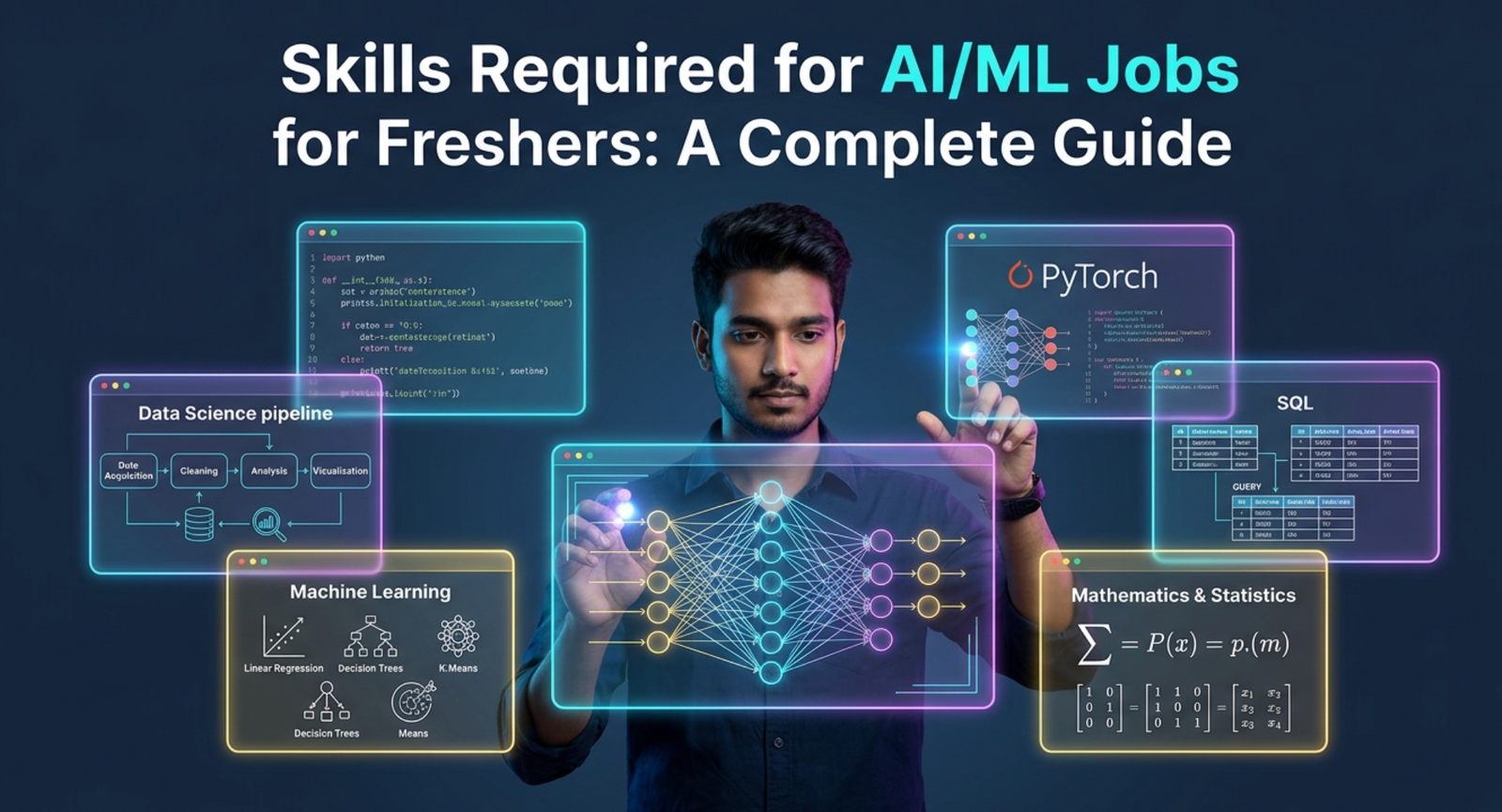
Python is the single most important skill for almost every AI/ML fresher role in India. It’s expected at a level where you can comfortably write functions, work with loops and conditionals, handle exceptions, and read someone else’s code without getting lost.
- Core Python syntax, data types, and control flow.
- Working with functions, list comprehensions, and basic object-oriented programming.
- File handling and reading/writing structured data (CSV, JSON).
- Debugging your own code rather than only writing it from scratch.
Some ML engineering-heavy roles also expect basic familiarity with a second language relevant to backend or systems work, such as Java or C++, but Python remains the baseline for almost every AI/ML posting.
2. Mathematics and Statistics Fundamentals
You don’t need a PhD-level grasp of theory, but a working understanding of the following comes up constantly in interviews and on the job:
- Linear Algebra: Vectors, matrices, matrix multiplication — the backbone of how most ML models represent data internally.
- Probability and Statistics: Mean, median, variance, standard deviation, probability distributions, hypothesis testing, and correlation vs. causation.
- Calculus (basic): Derivatives and gradients, mainly to understand how models like linear regression and neural networks are optimized.
Interviewers often test this conceptually rather than through heavy calculations — being able to explain what a p-value means, or why correlation doesn’t imply causation, matters more than deriving formulas from memory.
3. Data Structures and Algorithms
Even for AI/ML roles, many companies — especially larger tech firms — still test data structures and algorithms (DSA) as part of the interview process, since it signals general problem-solving ability.
- Arrays, strings, linked lists, stacks, and queues.
- Basic sorting and searching algorithms.
- Time and space complexity (Big-O notation) at a conceptual level.
- Hash maps/dictionaries, since they show up constantly in data processing tasks.
You don’t need competitive-programming-level DSA for most ML roles, but weak fundamentals here can eliminate you before you even get to the ML-specific questions.
4. Core Machine Learning Concepts
This is where AI/ML-specific preparation begins. At a fresher level, companies generally expect conceptual clarity plus the ability to implement standard algorithms using existing libraries, not build them from scratch.
- Supervised learning: Linear and logistic regression, decision trees, random forests, support vector machines, k-nearest neighbors.
- Unsupervised learning: Clustering (k-means), dimensionality reduction (PCA) at a basic conceptual level.
- Model evaluation: Accuracy, precision, recall, F1 score, confusion matrix, and understanding when accuracy alone is misleading (e.g., imbalanced datasets).
- Overfitting and underfitting: What causes them and basic techniques to address them, like regularization or cross-validation.
- Feature engineering: Handling missing data, encoding categorical variables, scaling numerical features.
5. Machine Learning Libraries and Tools
Employers expect hands-on familiarity with the standard Python ML stack, not just theoretical knowledge:
| Library/Tool | What It’s Used For |
|---|---|
| NumPy | Numerical computation and array operations |
| Pandas | Data manipulation, cleaning, and analysis |
| Matplotlib / Seaborn | Data visualization |
| Scikit-learn | Implementing standard ML algorithms and evaluation metrics |
| Jupyter Notebook | Interactive coding and experimentation |
If a role involves deep learning specifically, add familiarity with TensorFlow or PyTorch — most companies are fine with exposure to just one of the two rather than expecting mastery of both.
6. Data Handling and SQL
A large share of real AI/ML work is actually data work — sourcing, cleaning, and understanding data before any modeling happens. SQL comes up in almost every data-adjacent interview, regardless of how “AI-focused” the role sounds on paper.
- Writing SELECT queries with filtering, sorting, and aggregation (GROUP BY, HAVING).
- JOINs across multiple tables.
- Basic understanding of database structure and normalization.
- Comfort with messy, real-world data — missing values, inconsistent formatting, duplicate records — since most datasets you’ll encounter on the job look nothing like a clean Kaggle dataset.
7. Deep Learning Basics (Role-Dependent)
Not every fresher AI/ML role requires deep learning, but if the posting mentions computer vision, NLP, or generative AI, expect these fundamentals to matter:
- How a basic neural network works — layers, weights, activation functions, backpropagation at a conceptual level.
- Common architectures relevant to the domain: CNNs for image-related work, RNNs/Transformers for text and sequence data.
- Basic exposure to pretrained models and fine-tuning, since building models from scratch is rare even in industry.
8. Version Control and Basic Software Practices
AI/ML work increasingly overlaps with standard software engineering, and companies notice when a fresher can’t work within a team’s existing workflow.
- Git and GitHub: Cloning repositories, committing changes, working with branches, and resolving basic merge conflicts.
- Writing readable, documented code rather than one-off notebook scripts nobody else can follow.
- Basic command-line comfort — navigating directories, running scripts, installing packages.
9. Cloud and Deployment Basics (Increasingly Expected)
You don’t need deep cloud expertise as a fresher, but basic exposure is increasingly common in job descriptions:
- Conceptual familiarity with at least one cloud platform — AWS, Google Cloud, or Azure.
- Basic understanding of how a trained model gets deployed as an API or service (even if you haven’t done it yourself).
- Awareness of what MLOps means at a high level — the idea that models need monitoring and retraining, not just a one-time training run.
10. Soft Skills That Actually Matter
Technical skills get you shortlisted; these often decide who actually gets hired between similarly qualified candidates:
- Explaining technical work in plain language — being able to describe what a model does and why, to someone without a technical background.
- Structured problem-solving — breaking an ambiguous problem into smaller, testable pieces rather than jumping straight to code.
- Curiosity and self-directed learning — the field moves fast, and interviewers often probe whether you’ve explored anything beyond your coursework.
- Attention to data quality — a surprising amount of AI/ML work is catching bad data before it becomes a bad model.
These soft skills matter just as much in the interview itself as on the job — see our Top 20 HR Interview Questions for Freshers guide for how to talk about your projects and skills clearly when it counts.
Skill Priorities by Role Type
| Role Type | Highest Priority Skills |
|---|---|
| Data Analyst / Junior Data Scientist | SQL, Excel, Pandas, statistics, data visualization |
| ML Engineer (Entry-Level) | Python, DSA, Git, scikit-learn, basic cloud/deployment awareness |
| Applied AI / Research Intern | Math foundations, PyTorch/TensorFlow, domain-specific algorithms (NLP/CV) |
| AI/ML Operations Support | Data annotation accuracy, basic SQL/Excel, structured documentation, process discipline |
How to Build Proof of These Skills as a Fresher
Listing skills on a resume only goes so far — freshers need some way to demonstrate them, since most won’t have professional experience yet.
- Build 2–3 solid projects rather than ten shallow ones. A well-documented project with a clear problem statement, your approach, and honest discussion of what didn’t work is more convincing than a dozen tutorial clones.
- Use real or realistically messy datasets where possible — Kaggle is a fine starting point, but projects using scraped or public government data show you can handle imperfect inputs.
- Maintain a clean GitHub profile with readable commit history and README files explaining each project, since recruiters and interviewers do check this.
- Participate in one or two Kaggle competitions — even a modest placement shows you can apply skills under a defined, competitive setting.
- Write about what you built — a short blog post or LinkedIn post explaining a project’s reasoning also demonstrates the communication skill mentioned above.
If you don’t have project experience yet, an internship is often the fastest way to build it under real guidance — browse current Internship Opportunities on FreshersJob4U.
Common Mistakes Freshers Make While Building AI/ML Skills
- Jumping straight to deep learning without solid fundamentals in statistics, classical ML, and data handling — most entry-level roles test these basics first.
- Collecting certificates instead of building projects. A stack of course-completion certificates with no applied work behind them rarely impresses interviewers.
- Only working with pre-cleaned datasets. Real jobs involve messy data; practicing exclusively on Kaggle’s cleanest datasets leaves a gap interviewers can spot quickly.
- Ignoring SQL because it “isn’t AI.” A large share of entry-level data/AI roles use SQL daily — skipping it because it feels less exciting is a common and costly mistake.
- Not being able to explain your own project. If you can’t clearly explain why you chose a particular model or metric, interviewers assume you copied the approach without understanding it.
Frequently Asked Questions (FAQs)
Q1. Do I need a master’s degree to get an AI/ML job as a fresher?
No. Many entry-level AI/ML roles in India accept bachelor’s degree holders in Computer Science, IT, or related fields, provided the required technical skills and project work are demonstrated.
Q2. Is Python the only programming language I need to know?
For most AI/ML fresher roles, yes — Python is the primary expectation. Some ML engineering-heavy roles may also value basic familiarity with Java, C++, or SQL, but Python remains the core requirement across almost all postings.
Q3. Should I learn TensorFlow or PyTorch first?
Either is a reasonable starting point; most companies don’t expect fresher-level candidates to know both. PyTorch has become more common in research and newer industry work, while TensorFlow still appears often in production environments — check the specific job posting if you want to prioritize one.
Q4. How much math do I actually need for an AI/ML job?
A working conceptual understanding of linear algebra, probability/statistics, and basic calculus is generally sufficient for entry-level roles. Deep theoretical math is more relevant for research-focused positions than typical industry fresher roles.
Q5. Are Kaggle competitions necessary to get hired?
Not strictly necessary, but they’re a useful way to demonstrate applied skills under a defined problem and can be a strong addition to a resume, especially in the absence of professional experience.

Engineering graduate and founder of FreshersJob4U. I write detailed job guides, interview prep resources, and career roadmaps for freshers and early-career professionals in India. This site started from my own experience with the scattered, confusing fresher job search — I wanted to build something cleaner.